
The Concrete Pump Elbow Pipes Selection & Maintenance Checklist
Updated: Aug 5
You're mid-pour on a sweltering afternoon when a sudden blowout at the 90-degree bend brings the entire site to a grinding halt. It's a scenario every operator fears, yet many of these costly failures stem from how we select and manage our concrete pump elbow pipes. We understand that the bends are the highest-stress points in any delivery line. It's incredibly frustrating when a component you thought was "good enough" fails right when the pressure is on, leading to messy clean-outs and lost hours.
Whether you're dealing with frequent blockages or feeling confused about the durability of cast manganese versus twin-wall options, you need a strategy that prioritises reliability. This guide will show you how to master the selection and upkeep of your elbow pipes to eliminate unexpected downtime and significantly extend your pipeline's lifespan on Australian sites. We'll explore the technical differences between hardened materials, explain how to stay compliant with current ASME B30.27 safety standards, and provide a practical maintenance checklist to keep your flow smooth and your gear ready for the next big pour.
Table of Contents
Understanding Concrete Pump Elbow Pipes: Types and Applications
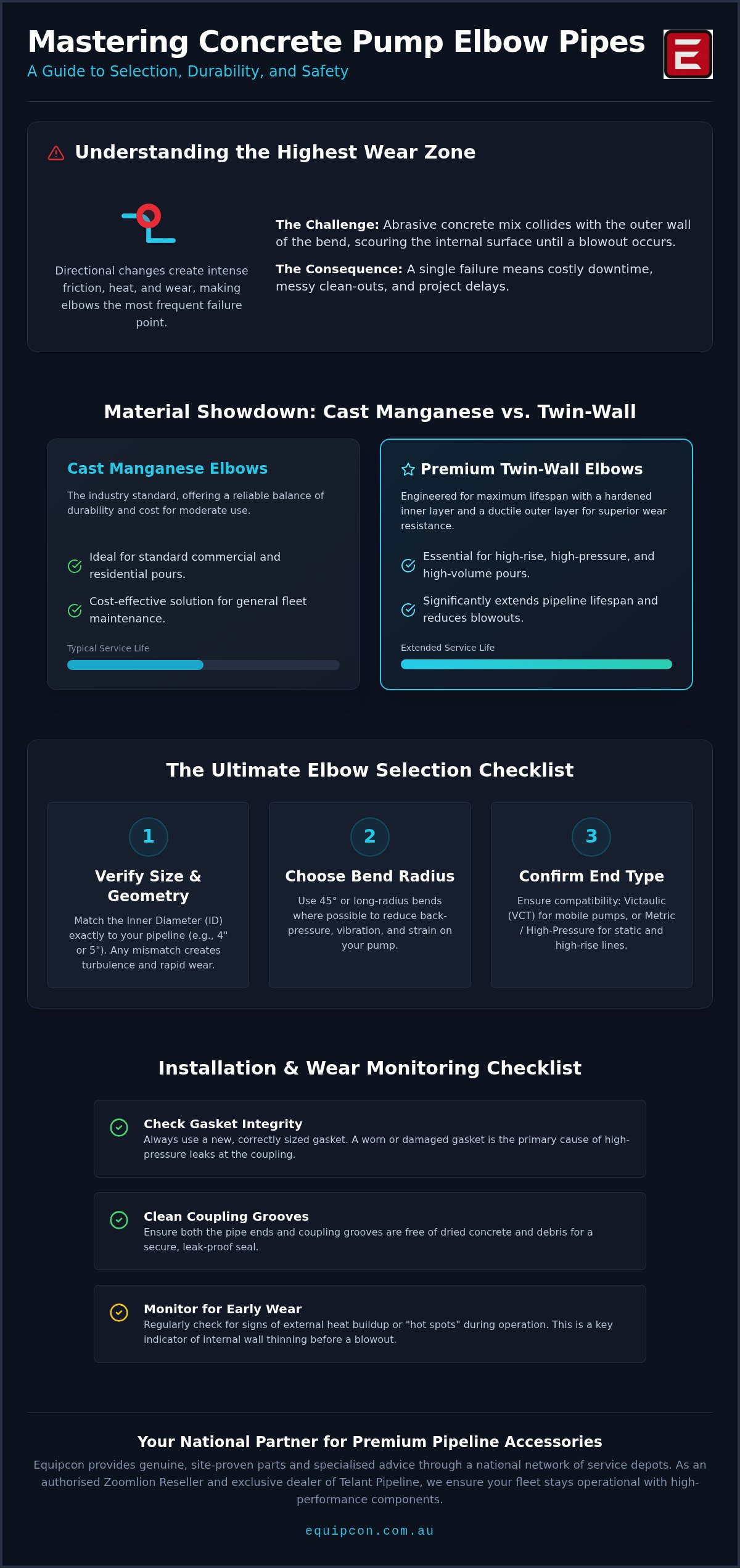
Think of concrete pump elbow pipes as the joints of your delivery system. They are the critical junction points that redirect the flow of abrasive mix from the hopper to the pour face. Because these components force a change in direction, they naturally become the highest wear-zones in any pumping setup. While a straight pipe allows the concrete to glide through with minimal resistance, an elbow forces the aggregate to collide with the outer wall of the bend. This constant bombardment creates intense friction and heat, eventually scouring away the internal surface until a blowout occurs.
The geometry of these bends also plays a massive role in your fleet’s overall performance. A tight bend radius increases back-pressure on your concrete pump, which forces the engine to work harder and consumes more fuel. If the flow becomes too turbulent within the elbow, you also risk aggregate segregation, where the stones and paste separate, leading to a higher chance of blockages. Industry data shows that using hardened materials, such as 45Mn2 steel, can help a pipe last for over 15,000 m³, which is a significant improvement over standard unhardened options.
Your choice of elbow also depends on where it sits in the line. Boom elbows need to be durable yet manageable in weight to avoid overstressing the boom structure. In contrast, deck or static line elbows are often stationary and can afford to be heavier, focusing purely on maximum wall thickness to handle high-pressure, high-volume civil pours. Keeping the right concrete pump elbow pipes on hand for each specific application is the first step toward reducing your maintenance costs.
Standard Degree Bends and Their Uses
90-degree elbows are the industry standard, essential for hopper exits and navigating the sharp turns required on a placing boom. However, they aren't always the most efficient choice for long-distance lines. If your site layout allows for it, using 45-degree or 15-degree bends is a much better way to reduce flow resistance. These shallower angles allow the concrete to maintain momentum, which puts less strain on your pump's hydraulic system. Whenever possible, opt for long radius elbows over short radius versions; the more gradual transition significantly lowers the impact force of the aggregate against the pipe wall.
End Types: Victaulic vs. Metric vs. High-Pressure
Identifying the correct coupling interface is vital for maintaining a leak-proof seal. Most mobile pumping setups in Australia utilise Victaulic (VCT) ends. These are popular because they allow for quick assembly and offer reliable performance under standard operating pressures. If you're working on high-rise stationary projects or specialised civil works, you'll likely encounter metric ends or high-pressure male/female interfaces. It's a good idea to double-check your existing pipeline specs before ordering replacements. Even a slight mismatch in the end type can lead to dangerous pressure leaks or coupling failure during a pour, which is a headache no operator wants to deal with.
The Ultimate Selection Checklist: Choosing the Right Elbow
Selecting the right component shouldn't be a guessing game, especially when a single failure can derail your entire day's production. While many treat these parts as simple commodities, the right concrete pump elbow pipes act as a safeguard for your pump's hydraulic system and your crew's safety. We've seen too many operators struggle with mismatched gear that leads to premature wear or, worse, dangerous leaks under pressure. By following a structured selection process, you can ensure your pipeline remains a reliable asset rather than a constant source of stress.
Step 1: Size and Geometry Requirements
Precision is your best friend when measuring for replacements. You must verify that the inner diameter (ID) matches your existing pipeline exactly, typically 4-inch or 5-inch in the Australian market. While the outside diameter (OD) might look similar across different brands, any internal lip or "step" created by mismatched IDs will cause immediate turbulence and rapid wear. Beyond the diameter, consider the degree of bend. While a 90-degree elbow is standard for tight hopper exits, using a long-radius 45-degree bend in your deck line can significantly reduce "elbow kick" and vibration. This smoother transition keeps the concrete moving with less resistance, which protects your couplings and reduces the physical workload on your pump.
Step 2: Pressure and Material Compatibility
The abrasive nature of your mix dictates the material you need. If you're regularly pumping harsh aggregates like crushed basalt, standard steel won't cut it for long. You'll need hardened alloys or elbows with reinforced "wear backs" (extra thickness on the outer radius) to handle the impact. It's also vital to match the pressure rating of the elbow to your pump's maximum bar output. Adhering to OSHA standards for concrete pumping and local safety regulations ensures that every component in your line is rated for the task at hand. Operating a pipeline where the elbow's pressure rating is lower than the pump's capability creates a high-risk environment for catastrophic component failure. Choosing a pressure rating that exceeds your pump’s maximum output is a non-negotiable requirement for maintaining a safe and professional job site.
Before you commit to a purchase, run through this quick verification list to ensure total system harmony:
Confirm the ID matches your delivery line to prevent flow disruption.
Select hardened materials if your typical mix contains high-fines or abrasive stone.
Inspect the elbow for reinforced impact zones to maximise service life.
Ensure the end types are standardised to fit your current concrete pump pipe couplings without modification.
If you're unsure about the best fit for your specific rig or upcoming project, the team at Equipcon can help you audit your current pipeline setup to ensure everything is optimised for performance.
Cast Manganese vs. Twin-Wall: Which Elbow Wins?
Deciding between cast manganese and twin-wall concrete pump elbow pipes isn't just a matter of looking at the price tag on an invoice. It's a strategic choice that affects your rig's payload, your crew's safety, and your long-term maintenance budget. While both options serve the same basic purpose, their performance under pressure varies significantly depending on the application. Choosing the wrong type for a high-volume pour can lead to premature thinning and unexpected failures that stall your progress.
Operators often find themselves balancing the upfront cost of premium components against the labour-intensive reality of frequent replacements. If you're running a high-rise stationary pump, your needs will differ vastly from a contractor managing a small mobile unit for residential slabs. Understanding the metallurgy and construction of these parts allows you to make an informed decision that keeps your pipeline operational for longer.
Cast Manganese Elbows: The Industry Workhorse
Cast manganese has earned its reputation as the traditional go-to for many Australian operators. This material possesses a unique property: it "work-hardens" under the constant impact of abrasive aggregate. As the concrete slams into the outer radius of the bend, the surface of the manganese actually becomes tougher and more wear-resistant. This makes cast elbows an excellent choice for the first bend off the hopper, where turbulence is at its peak.
However, you must be vigilant about casting flaws. Because these are poured in a foundry, internal air pockets or "blowholes" can occasionally occur, creating weak spots that wear through faster than the rest of the pipe. When selecting cast gear, ensure it meets the CPMA Safety Standard for structural integrity. Always inspect new cast elbows for any surface irregularities before installation to avoid surprises mid-pour.
Twin-Wall Technology: The Premium Alternative
Twin-wall technology represents the next level of pipeline optimisation. These concrete pump elbow pipes consist of two distinct layers: a highly hardened, heat-treated inner liner and a ductile outer pressure shell. The inner sleeve is designed purely for wear resistance, often utilising materials like 45Mn2 steel, which can achieve a service life of over 15,000 cubic metres in the right conditions. The outer shell provides the structural strength needed to contain the pressure, acting as a failsafe if the inner liner eventually wears through.
One of the biggest advantages of twin-wall is the weight-to-durability ratio. For boom pumps, every kilogram of weight saved on the pipeline reduces the stress on the boom structure and hydraulics. Twin-wall elbows are often lighter than their thick-walled cast counterparts while offering superior longevity. You can identify a genuine twin-wall component by checking the end collars; a true twin-wall will show a visible seam where the inner liner is inserted into the outer housing. While the initial investment is higher, the reduced replacement frequency and lower freight costs usually result in a much better return on investment for high-volume contractors.
Installation and Wear Monitoring Checklist for Operators
Installing your concrete pump elbow pipes correctly is only half the battle. To truly maximise your pipeline's longevity, you need a proactive monitoring strategy that identifies wear before it turns into a catastrophic blowout. A blowout doesn't just waste material; it endangers your crew and can cause hours of messy clean-up that eats into your margins. By treating your elbows as high-maintenance components rather than "set and forget" parts, you'll ensure your rig stays operational through even the most demanding pours.
One simple but often overlooked tactic is the periodic rotation of your elbows. Because the aggregate always hits the outer radius with the most force, that specific area thins out much faster than the rest of the pipe. If you rotate the elbow by 90 or 180 degrees every few thousand cubes, you distribute that impact zone across a fresh surface. This small adjustment can effectively double the service life of a single component without costing a cent in parts.
Proper Installation Steps
Success starts with a clean interface. Before every pour, you must thoroughly clean the coupling grooves to remove any dried slurry or grit. Even a tiny amount of debris can prevent a leak-proof seal, leading to pressure loss or gasket failure mid-job. Ensure the pipeline is perfectly aligned to reduce lateral stress on the elbow's ends. Forcing a connection puts unnecessary tension on your concrete pump pipe couplings, which can lead to cracked collars. For boom elbows, always secure the line with safety slings or "whip checks." These are essential safety measures that prevent a pipe from swinging wildly if a coupling fails under high pressure.
Visual Inspection and Wear Signs
Operators should keep a sharp eye out for "hot spots" on the outer radius while pumping. If a specific patch on the elbow feels significantly hotter than the surrounding metal, it's a clear sign that the internal wall has thinned dangerously. You should also look for external pitting or grooving, which often signals that the internal hardened layer has been breached. While many old-school operators rely on the "knock test"—listening for a dull thud versus a sharp ring when hitting the pipe with a hammer—this is subjective. For absolute certainty, perform ultrasonic thickness testing on your high-use bends. If the measurement falls below the manufacturer’s recommended minimum, pull the elbow from service immediately. It's always better to replace a worn bend in the yard than to deal with a failure on-site.
If your current bends are showing signs of premature thinning, it might be time to upgrade to a more durable solution. You can browse our full range of high-durability concrete pump elbow pipes and spares at Equipcon to find the right fit for your fleet.
Sourcing Premium Pipeline Accessories with Equipcon
Mastering the technical side of your delivery line is a massive step toward efficiency, but your efforts only pay off if you have a reliable supply chain backing you up. We've seen how the right concrete pump elbow pipes can transform a high-pressure pour from a stressful ordeal into a routine success. At Equipcon, we don't just sell components; we provide site-proven solutions that have been tested against the harshest Australian conditions. Our commitment to high-durability gear ensures that when you install one of our elbows, you're getting a part designed to go the distance.
Reliability is especially critical when you're managing a fleet of diverse machinery. Whether you are running Zoomlion, Schwing, or Sany systems, our technical team offers expert advice on matching the exact specifications for your rig. We maintain an extensive stock across our national network of service depots, meaning you aren't left waiting for international shipping while your project sits idle. By providing immediate access to concrete pump spare parts Australia wide, we help you keep your downtime to an absolute minimum.
Why Sourcing Quality Matters for Australian Contractors
Choosing "cheap" pipeline components often turns out to be the most expensive mistake a contractor can make. If a bargain elbow fails on a remote site in the Pilbara or during a critical infrastructure pour in Sydney, the cost of the replacement part is nothing compared to the lost labour, wasted concrete, and potential liquidated damages. We focus on supplying gear that supports national infrastructure projects, ensuring every bend and coupling meets the required safety and performance benchmarks.
Our support doesn't end at the point of sale. If your crew is struggling with frequent pipeline blockages or unusual wear patterns, our technical team is ready to help you troubleshoot the issue. We look at the whole picture, from your mix design to your pipeline layout, to identify why your concrete pump elbow pipes might be failing prematurely. This proactive partnership is what separates a simple supplier from a dedicated industry ally.
Get the Right Gear for Your Next Pour
If you're looking to upgrade your current setup or need to restock your yard, we make the process straightforward and transparent. You can request a comprehensive pipeline audit where we assess your current wear rates and recommend the best material—whether that’s cast manganese or twin-wall—for your specific workload. We also provide bulk spare parts quotes to help you manage your maintenance budget more effectively.
Our national service and repair network is always ready to assist with specialised technical expertise, ensuring your equipment stays in peak condition. Don't wait for a blowout to think about your pipeline’s health. Contact the team at Equipcon today for expert advice and high-pressure accessories that keep your business moving forward.
Optimise Your Pipeline for the Long Haul
Treating your concrete pump elbow pipes as a strategic investment rather than a disposable commodity is the fastest way to improve your site efficiency. By selecting the right metallurgy for your specific mix and implementing a disciplined rotation and monitoring schedule, you can effectively double the lifespan of your bends. These proactive steps don't just save money on parts; they protect your crew and ensure your rig stays operational during those critical high-pressure pours.
Equipcon is here to support your success with an extensive inventory of heavy-duty pipeline spares and specialised technical support for all major pump brands. With national service depots located in VIC, SA, WA, and QLD, we're always ready to help you troubleshoot blockages or audit your current setup for better performance. Our team understands the local conditions you face and is dedicated to keeping your fleet ready for action.
Ready to upgrade your delivery system? View our range of high-performance pipeline accessories at Equipcon to ensure your next project runs as smoothly as possible. We're looking forward to helping you get the most out of your gear.
Frequently Asked Questions
How long should a concrete pump elbow pipe last?
Service life depends heavily on the material used, but a hardened 45Mn2 pipe can realistically last for over 15,000 m³ under standard conditions. Factors such as the abrasiveness of your aggregate and the operating pressure of your pump will dictate the actual lifespan. If you're regularly pumping harsh civil mixes, you'll naturally see a faster wear rate than an operator handling standard residential concrete.
What is the difference between a 90-degree and a long-radius elbow?
A long-radius elbow features a more gradual curve than a standard 90-degree bend, which helps to reduce flow resistance and back-pressure. This smoother geometry lowers the impact force of the aggregate against the internal pipe wall. While standard 90s are essential for tight hopper exits and boom configurations, long-radius bends are the preferred choice for deck lines to minimise vibration and "elbow kick."
Can I use a line pump elbow on my boom pump?
You should only use elbows that are specifically rated and weighted for boom applications on your boom pump. While the inner diameter might match your line pump gear, boom-specific concrete pump elbow pipes are engineered to avoid overstressing the boom's structural hydraulics. Using a heavy, static-line cast elbow on a boom can lead to weight-limit issues or structural fatigue over time.
Why do my elbow pipes always wear out in the same spot?
Wear almost always concentrates on the outer radius because that's the primary impact zone where the abrasive mix is forced to change direction. To combat this, many premium elbows are designed with reinforced "wear backs" that provide extra wall thickness in that high-impact area. You can significantly extend the life of the component by rotating it 90 degrees periodically to distribute the wear across a fresh surface.
What are the signs that a concrete pump elbow is about to fail?
The most reliable signs of impending failure are "hot spots" on the outer bend during a pour or visible external pitting on the pipe surface. If one patch of the elbow feels significantly hotter than the rest of the line, it's a clear indication that the internal wall has thinned dangerously. While some operators rely on a hammer test, using an ultrasonic thickness tester is the only way to get an accurate measurement.
Are twin-wall elbows worth the extra cost for residential pumping?
Twin-wall elbows are usually a better investment for high-volume commercial contractors rather than occasional residential pumpers. If you're only handling small house slabs a few times a week, a high-quality cast manganese elbow is often the most cost-effective solution. However, if your rig is working daily on high-volume projects, the reduced replacement frequency of twin-wall technology will eventually save you more in labour and downtime.
What is the best material for pumping highly abrasive concrete mixes?
Hardened alloys or twin-wall concrete pump elbow pipes with a heat-treated inner liner are the superior choice for handling abrasive mixes. These materials are specifically engineered to resist the scouring action of harsh aggregates better than standard mild steel. If your typical mix contains crushed basalt or high-fines sand, investing in premium hardened components will prevent the frequent, messy blowouts that stall your production.
How do I know if my couplings are compatible with a new elbow?
You must verify that the end type of the elbow matches your existing system, whether you're using Victaulic (VCT), Metric, or high-pressure male/female ends. Check the flange diameter and the groove profile carefully before you commit to a purchase. Mismatched ends won't just lead to messy leaks; they can fail catastrophically under pressure, so it's vital to confirm your pipeline specs with a technical specialist.


Comments