
Mobile Concrete Pumps for Sale: The Ultimate Guide for Australian Contractors
Updated: Jul 29
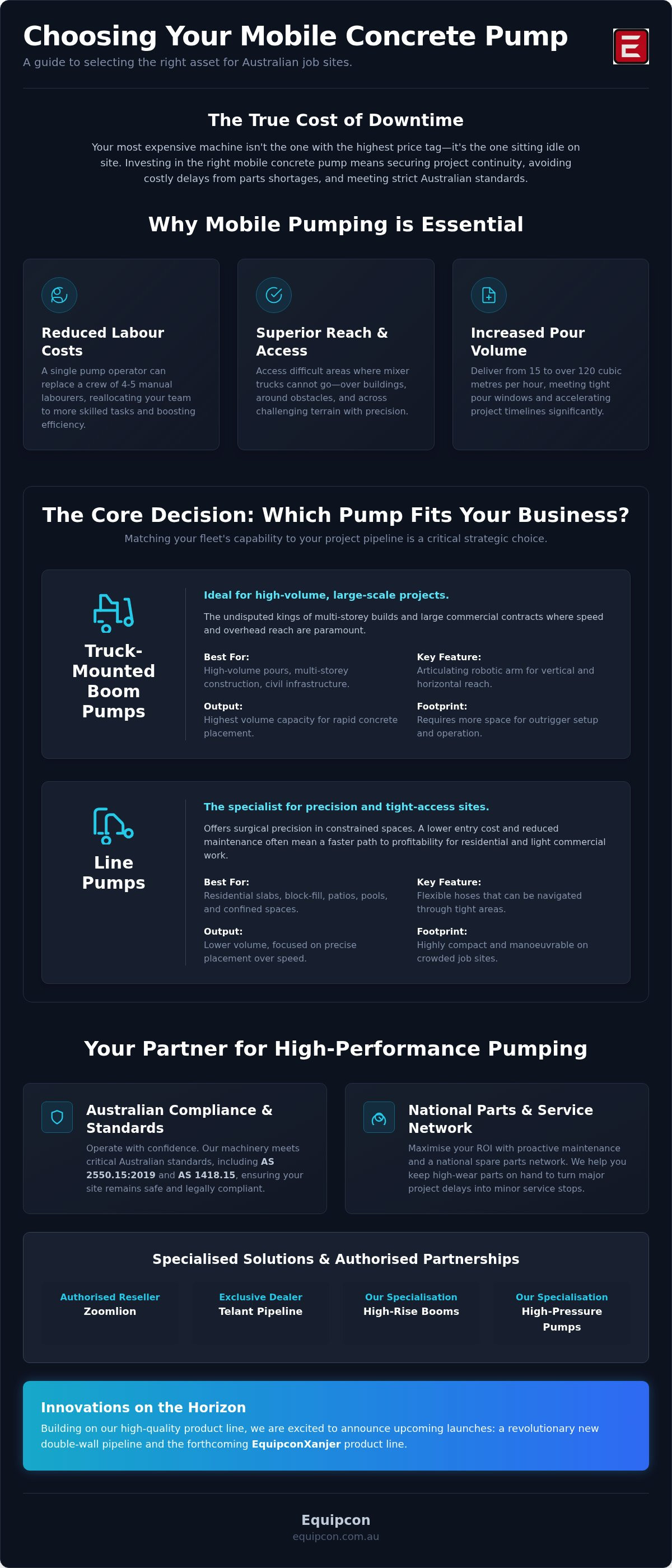
Your most expensive piece of machinery isn't the one with the highest price tag; it's the one sitting idle on a job site because a small hydraulic component is stuck in a warehouse overseas. Investing in mobile concrete pumps is a significant move that should drive your business forward, not stall it with maintenance headaches or parts shortages. We understand the frustration of trying to keep up with strict Australian standards while deciding whether a versatile boom pump or a compact line pump will actually deliver the best return for your specific project mix.
It's a challenge to balance high-performance output with the complex compliance requirements found on modern Australian sites, such as the updated AS 2550.15:2019 standards. This guide will show you exactly how to select a reliable machine that meets local regulations and keeps your crew moving. We'll explore how to maximise your ROI through proactive maintenance, the importance of a national spare parts network, and the latest 2026 regulatory changes you need to know. Whether you're looking to reduce manual labour or scale your operations, you'll find the expert insights required to make an informed, profitable investment.
Table of Contents
What are Mobile Concrete Pumps and Why are They Essential for Australian Sites?
Truck-Mounted Boom Pumps vs. Line Pumps: Choosing the Right Asset
Technical Specifications and Australian Compliance Standards
Maximising ROI: Maintenance, Spare Parts, and Reducing Downtime
Why Equipcon is the Preferred Partner for Mobile Concrete Pumps
What are Mobile Concrete Pumps and Why are They Essential for Australian Sites?
In the vast expanse of the Australian construction landscape, the "tyranny of distance" isn't just a historical concept; it's a daily logistical hurdle. Whether you're pouring a residential slab in a tight suburban cul-de-sac or working on a remote civil infrastructure project, getting concrete exactly where it needs to go requires more than just a mixer truck. This is where mobile concrete pumps become indispensable. These units are designed for high mobility, allowing contractors to move equipment rapidly between various sites across the country without the need for heavy haulage permits or complex setups.
To understand the basics, What is a Concrete Pump essentially involves a machine that transfers liquid concrete by pumping. In the Australian context, a mobile concrete pump is a dual-role transport and delivery vehicle that eliminates the need for manual handling while ensuring a continuous, high-speed flow of material. By shifting from traditional manual pouring methods to mechanised pumping, site managers can significantly improve project timelines and safety outcomes.
The Evolution of Pumping Technology in Australia
The industry has come a long way from the basic mechanical pumps used decades ago. Today, advanced hydraulic systems have replaced clunky gear-driven units, offering smoother flow and much higher pressure for demanding Australian conditions. Modern mobile concrete pumps now feature sophisticated wireless remote controls, allowing operators to position themselves exactly where the pour is happening for maximum visibility. This precision reduces waste and minimises the physical toll on workers, as the machine does the heavy lifting that once required teams of labourers with wheelbarrows and shovels.
Key Benefits: Efficiency, Labour Savings, and Reach
The commercial argument for these machines is simple: they do more with less. By investing in the right equipment, you transform your site's productivity through several key advantages:
Reduced Labour Costs: A single pump operator can often replace a crew of four or five workers, allowing you to reallocate your team to more skilled tasks.
Superior Reach: Whether it's reaching over a two-storey house or navigating around established trees on a heritage site, these units access areas where a traditional mixer truck simply cannot go.
Increased Volume: Modern pumps can deliver anywhere from 15 to 120 cubic metres per hour, which is essential for meeting tight pour windows in the harsh Australian heat.
By integrating these assets into your fleet, you aren't just buying a tool; you're securing the ability to take on more complex, higher-margin work that manual sites simply can't handle. From small backyard extensions to massive bridge foundations, the versatility of these units makes them a foundational asset for any serious contractor—and if your business growth requires new site acquisitions, you can explore Buying Properties Conveyancing with i.Conveyancing.Co to ensure your legal transitions are as smooth as your pours.
Truck-Mounted Boom Pumps vs. Line Pumps: Choosing the Right Asset
Selecting between the two primary types of mobile concrete pumps is a strategic decision that goes beyond simple reach. It's about matching your fleet's capabilities to the specific demands of your project pipeline. While both machines serve the same fundamental purpose, their mechanical DNA and site footprints create vastly different commercial outcomes. A boom pump offers speed and overhead clearance, while a line pump provides surgical precision in tight spaces where a truck-mounted arm simply cannot unfold.
The choice often comes down to your business model. If you're consistently winning high-volume commercial contracts, the higher capital investment of a boom pump is offset by its massive output. For those focusing on residential or light commercial work, the lower entry point and reduced maintenance of a line pump often result in a faster path to profitability. If you're looking to expand, the team at Equipcon can help you compare technical specifications to ensure your next asset matches your growth targets.
When to Invest in a Concrete Boom Pump
Boom pumps are the undisputed kings of high-volume pours and multi-storey builds. Featuring an articulating arm that can extend anywhere from 20 metres to over 60 metres, these units allow you to clear obstacles like fences, existing structures, or sensitive landscaping with ease. On Australian worksites, the primary constraint isn't just the height; it's the ground. You must account for the outrigger footprint. If a site is too congested to fully extend the stabilisers, the boom cannot safely operate. Adhering to Australian safety and compliance standards is critical here, especially when assessing soil bearing capacity and proximity to overhead power lines.
The Versatility of Mobile Line Pumps
For residential footpaths, driveways, and internal pours, the line pump is your most versatile asset. These units pump concrete through flexible hoses manually laid out along the ground, making them ideal for sites with restricted access or low overhead clearance. They are significantly easier to transport and require a much smaller site footprint than their boom-mounted counterparts. For contractors starting a new pumping business, a line pump offers a manageable entry point with lower hydraulic complexity and simplified maintenance routines. This makes them a reliable "bread and butter" machine for a specialised fleet, providing consistent work across a wide variety of smaller-scale urban projects.
Technical Specifications and Australian Compliance Standards
When you're looking at mobile concrete pumps, the spec sheet tells a story that goes beyond mere horsepower. In the Australian market, the most critical number isn't the engine's output, but the compliance rating. Every machine operating on a professional site must adhere to AS 1418.15, the Australian Standard for concrete placing units. This standard governs everything from structural integrity to safety systems. If a machine doesn't meet these rigorous benchmarks, it's not just a safety risk; it's a liability that could see you banned from major Tier 1 project sites. Ensuring your asset is "AU-ready" from day one is the best way to protect your investment.
Beyond compliance, you need to evaluate the machine's performance metrics through the lens of your typical workload. Most contractors focus on the maximum output, measured in cubic metres per hour (m³/h), but the concrete pressure (measured in bar) is equally vital. High-pressure systems are essential when you're pushing stiff Australian mixes over long distances or up several storeys. If your pump has high volume but low pressure, you'll find the machine struggling and fuel consumption spiking as the hydraulic system works overtime to overcome line resistance.
The heart of these machines lies in the hydraulic configuration. You'll generally choose between open and closed-loop systems. While closed-loop systems are often praised for their fuel efficiency and smoother transitions, open-loop systems remain popular for their straightforward maintenance and reliability in heat-intensive environments. This hydraulic choice, combined with a well-engineered hopper and agitator, determines how well the machine handles varied aggregate sizes. A robust agitator ensures the mix remains homogenous, preventing the blockages that lead to costly downtime during a critical pour.
Safety Features and Operator Controls
Modern safety goes far beyond a simple emergency stop button. Leading mobile concrete pumps now feature integrated stability sensors that prevent boom operation if outriggers aren't correctly deployed or if the ground pressure shifts dangerously. Hopper grates with safety interlocks are standard, ensuring the pump stops instantly if the lid is opened. The surgical precision of a modern hydraulic system ensures the placing boom remains stable and predictable, which is the single most important factor in preventing site accidents during a high-pressure pour. High-quality radio remote systems further enhance this by allowing the operator to stand in the best possible position for visibility without being tethered to the truck.
Engine Performance and Environmental Considerations
With environmental regulations tightening across the country, engine Tier ratings have become a significant talking point. Choosing a machine with a modern, low-emission engine isn't just about being "green"; it's about future-proofing your fleet for work in urban centres where noise and exhaust restrictions are strictly enforced. Noise reduction technology is particularly valuable if you're frequently working in residential zones with early morning starts. Finally, don't overlook the chassis. Given the vast distances between Australian towns, your pump needs a robust, locally supported truck chassis that can handle long highway hauls and the corrugated access roads common on regional sites.
Maximising ROI: Maintenance, Spare Parts, and Reducing Downtime
The true value of your equipment isn't found on the invoice; it's found in its availability on the job site. When mobile concrete pumps are sidelined due to a preventable mechanical failure, the costs ripple through your entire project. You're not just losing the hourly rate of the pump; you're paying for idle crews and potentially facing penalties for delayed pours. Adopting a proactive maintenance stance is the only way to safeguard your return on investment and keep your business moving forward.
Concrete is inherently abrasive, meaning certain components are designed to be sacrificial. To keep your operation moving, you should always have a "first-aid kit" for your machine. This includes wear plates, cutting rings, and gaskets. If these parts aren't replaced when they reach their wear limits, you'll experience a loss of pressure and increased internal friction. This eventually damages the more expensive hydraulic heart of the unit, turning a simple part replacement into a major repair bill.
Your pipeline and accessories are just as critical as the pump itself. Using high-quality, heat-treated pipes reduces the risk of dangerous blowouts that can halt a site for hours. A daily inspection for hydraulic leaks and weekly checks on pipe wall thickness are non-negotiable. Catching a weeping hose on a Monday morning is far better than dealing with a burst line in the middle of a Friday afternoon pour. Consistent maintenance isn't just about safety; it's about the logistical precision that defines a professional contractor.
The Critical Spare Parts Checklist
Having the right parts on the shelf can be the difference between a one-hour delay and a three-day shutdown. Every operator should maintain a stock of these essentials:
Wear plates and rings: These are the heart of the pumping unit and take the most punishment from the mix.
Hydraulic filters and hoses: Keeping the lifeblood of your machine clean is the simplest way to prevent a total system overhaul.
Pipeline accessories: Stock plenty of couplings, seals, and washout balls to ensure efficient cleaning at the end of every shift.
Professional Repair Services vs. Field Fixes
While basic maintenance can be handled by your team, complex hydraulic overhauls and annual structural boom inspections require a specialist's touch. Attempting a complex field fix on sophisticated mobile concrete pumps can lead to safety risks and voided warranties. Relying on a national service network with depots in Victoria, South Australia, Western Australia, and Queensland ensures that wherever your project takes you, expert help is nearby. Using genuine spare parts during these repairs protects the resale value of your machinery and keeps it compliant with Australian standards. If you need to restock your inventory or book a service, you can order genuine parts and accessories through our national network.
Why Equipcon is the Preferred Partner for Mobile Concrete Pumps
Choosing a machinery supplier is a decision that affects your business for years, not just the day the delivery truck arrives. At Equipcon, we position ourselves as the "Reliable Specialist" because we understand that our success is tied to yours. We don't just sell mobile concrete pumps; we provide a complete operational framework designed to keep your projects profitable. From the initial consultation where we help you select the right asset to the long-term maintenance support that follows, our team is deeply invested in the functional success of your fleet.
We provide turnkey solutions that take the stress out of asset acquisition. This means every machine we deliver is ready for immediate work on Australian sites, fully compliant and backed by a team that speaks your language. We prioritise transparent and honest communication, especially when it comes to logistical schedules or technical support. Our goal is to act as an extension of your own business, providing the proactive care required to reduce downtime and ensure your crew stays productive.
A National Network for Local Support
Our national footprint is a core part of our commitment to your business. With dedicated depots across Victoria, South Australia, Western Australia, and Queensland, we ensure that technical assistance is never out of reach. This "boots-on-the-ground" approach allows us to respond quickly to your needs, whether you require a specialised repair or a critical component delivered to a remote site. Dealing with people who understand the specific environmental and regulatory conditions of Australian worksites makes a significant difference in how quickly you can resolve challenges and get back to pouring.
Expertise in Zoomlion and Major Global Brands
As an authorised distributor, we offer specialised knowledge in high-performance brands like Zoomlion while maintaining compatibility with other major global manufacturers. This specialised expertise means our technicians can perform complex hydraulic overhauls and repairs with a level of precision that general mechanics simply cannot match. Sourcing genuine parts and accessories through our network protects your warranty and ensures your machinery continues to operate at its peak performance level. If you're ready to upgrade your fleet or add a new asset to your business, you can view our current range of mobile concrete pumps for sale to find the perfect match for your next project.
Empowering Your Fleet with Reliable Pumping Assets
Managing a successful construction business in Australia requires equipment that is as tough and resilient as the sites you work on. We've seen how selecting the right mobile concrete pumps depends on a clear understanding of your project mix, from high-reach boom requirements to the surgical precision of line pumps. By prioritising Australian compliance and a rigorous maintenance schedule, you don't just avoid downtime; you build a reputation for reliability that wins more contracts.
Success in this industry is rarely a solo effort. It requires a partner who provides more than just a storefront. Our national service depots in Victoria, South Australia, Western Australia, and Queensland are staffed by specialised hydraulic repair experts who understand the urgency of your timelines. We maintain a comprehensive stock of genuine spare parts and pipeline accessories to ensure your machinery remains a productive asset for years to come.
Enquire about our mobile concrete pumps and national support network to discover how we can help you scale your operations with confidence. We look forward to supporting your next big pour with the expert care and turnkey readiness your business deserves.
Frequently Asked Questions
What is the average lifespan of a mobile concrete pump in Australia?
A well-maintained mobile concrete pump typically has an operational lifespan of 10 to 15 years in the Australian construction industry. This longevity depends heavily on the volume of material pumped and the strictness of your preventative maintenance schedule. Regular structural inspections and hydraulic overhauls can extend this life, whereas neglecting wear components will lead to premature failure of the core pumping unit.
Do I need a specific licence to operate a truck-mounted boom pump?
You are legally required to hold a High Risk Work Licence (HRWL) Class PB to operate a truck-mounted boom pump on any Australian worksite. This certification ensures operators understand the safety risks associated with boom stability, outrigger placement, and overhead hazards. It is distinct from a standard heavy vehicle licence, which is also required to drive the truck-mounted unit between project locations.
How often should concrete pump wear plates and rings be replaced?
Wear plates and cutting rings typically require replacement every 2,000 to 5,000 cubic metres of concrete pumped. The exact frequency varies based on the abrasiveness of the aggregate and the pressure used during the pour. You should inspect these components daily; once the gap between the plate and ring exceeds the manufacturer's specification, replace them immediately to prevent internal pressure loss and hydraulic strain.
Can mobile concrete pumps handle high-strength or low-slump concrete mixes?
Modern mobile concrete pumps are engineered to handle high-strength and low-slump mixes, provided they are equipped with a high-pressure hydraulic system. These "stiff" mixes require more force to move through the pipeline, so ensuring your pump has the necessary bar pressure is essential. Using a well-designed hopper with a powerful agitator also helps maintain mix consistency and prevents blockages during these demanding pours.
What are the most common causes of downtime for mobile pumping units?
The most frequent causes of downtime are pipeline blockages, hydraulic hose failures, and delays in sourcing critical spare parts. Many blockages occur due to improper cleaning or poor mix design, while hydraulic issues often stem from neglecting minor leaks. Maintaining a local stock of high-wear components and using a national service network are the most effective ways to reduce these interruptions and keep your crew working.
How does the hydraulic system on a mobile pump differ from a stationary unit?
Hydraulic systems on mobile units are generally more complex than stationary pumps because they must power both the pumping mechanism and the articulating boom. While stationary pumps often use independent electric or diesel motors, mobile concrete pumps typically integrate with the truck’s Power Take-Off (PTO) system. This integration requires sophisticated cooling and filtration to handle the variable loads encountered during a typical multi-stage pour.
What should I look for in a second-hand mobile concrete pump vs. buying new?
Buying new provides the security of a manufacturer’s warranty and guaranteed compliance with the latest AS 1418.15 standards. If you choose a second-hand unit, you must verify its full service history and conduct a professional structural boom inspection to check for fatigue or cracks. While the initial cost is lower, you should factor in the potential for higher maintenance costs and the lack of modern safety features found on newer models.
Are spare parts for brands like Zoomlion and Schwing readily available in Australia?
Genuine spare parts for major brands like Zoomlion are readily available through national distributors with established depots across Australia. Having access to a local network in states like Victoria, Queensland, and Western Australia ensures you aren't waiting weeks for international shipping. This local availability is a critical factor in reducing downtime and maintaining the resale value of your equipment over its operational life.


Comments