

Impact of Aggregate Size on Pumping Concrete Mixes
For concrete pumping, coarse aggregate is generally limited to no more than one-third of the pipeline diameter. That makes the impact of aggregate size on concrete pumping a practical mix-selection issue: particles that are too large for the line can disrupt flow and increase the risk of a blockage.
Choosing larger aggregate may seem like a straightforward way to adjust a mix, but pumpability depends on more than particle size. Aggregate shape, the balance of fine material and the mix’s ability to maintain consistent flow all matter.
Here, you’ll learn how aggregate size affects pumpability, how to relate maximum particle size to pipeline diameter and which mix proportions help concrete move through a line. This gives you a clearer basis for planning a mix around the pipeline and placement requirements of an Australian project.
What Is The Maximum Aggregate Size For Pumping Concrete?
Coarse aggregate must suit both the pipeline opening and the mix’s ability to flow. Start by assessing the aggregate-to-pipe ratio, then account for particle shape and workability.
Coarse Aggregate and Pipe Flow
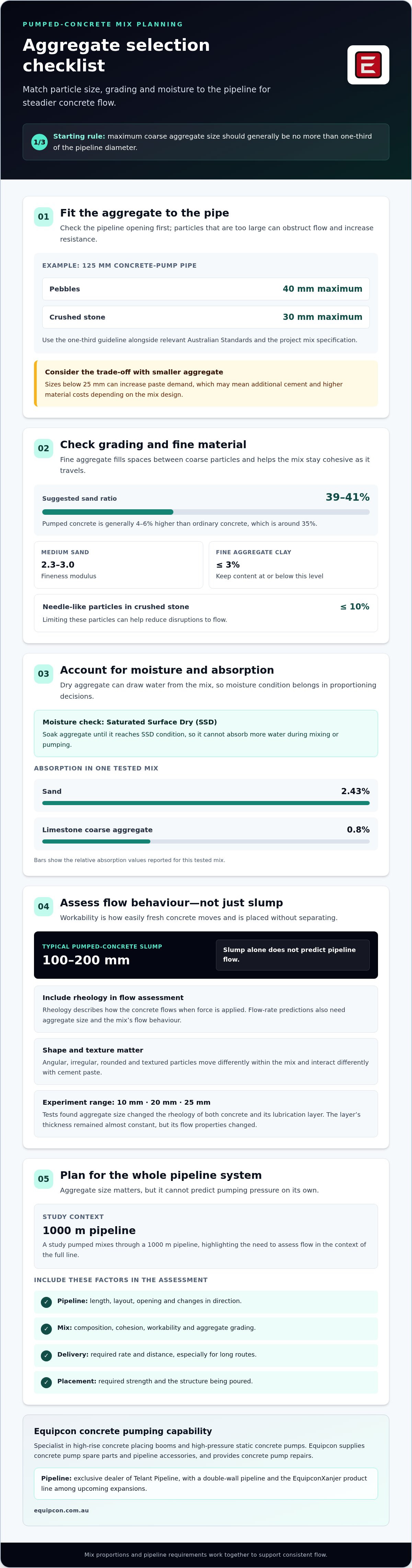
Coarse aggregate size describes the largest stones in the mix, and it influences how readily concrete passes through a pipe. For a 125 mm concrete-pump pipe, the maximum size is 40 mm for pebbles and 30 mm for crushed stone. Larger particles can obstruct flow, increasing resistance and the pressure needed to move the mix. Shape matters too: angular, irregular pieces interact differently with the cement paste and surrounding particles than rounded stones. These details help explain the impact of aggregate size on concrete pumping.
Workability and Concrete Flow
Workability is how easily fresh concrete moves and is placed without separating. Pumped concrete typically has a slump of 100-200 mm, but slump alone doesn’t predict flow through a pipeline. Flow-rate predictions also need to account for aggregate size and the mix’s rheology, or flow behaviour. In experiments, coarse aggregate size changed the rheology of both the concrete and its lubrication layer, while the layer’s thickness remained almost constant. Shape and texture influence how particles move within the mix, so they matter alongside cement content and composition.
Aggregate-to-Pipe Diameter Ratio
The general pumping guideline limits maximum aggregate size to no more than one-third of the pipeline diameter. For Australian projects, use this as a practical sizing guide alongside the relevant Australian Standards and project mix specification. Smaller aggregate may suit tighter pipe constraints, but sizes below 25 mm can increase paste demand. More paste may mean additional cement and higher material costs, depending on the mix design. Balance that consideration against the pipeline opening, required strength and the mix’s ability to maintain steady flow.
Aggregate selection for mix design
Aggregate selection shapes mix design by balancing flow, water demand and the strength needed for the structure. At constant cement content, larger aggregates generally require less mixing water, which can support higher concrete strength. But size is only one part of the selection: grading, particle shape, absorption and fine-aggregate content also influence the mix’s capacity to travel through a pipeline without separating.
Fine aggregate helps fill spaces between coarse particles and supports a cohesive mix. For pumped concrete, the sand ratio is generally 4-6% higher than for ordinary concrete. A suggested ratio is 39-41% when ordinary concrete is around 35%. Medium sand with a fineness modulus of 2.3-3.0 is recommended. Keep fine aggregate clay content at or below 3%, and needle-like particles in crushed stone at or below 10%, to limit disruptions to flow.
Moisture condition matters because dry aggregate can draw water from the mix. Soak aggregate until it reaches Saturated Surface Dry (SSD) condition, so it cannot absorb more water during mixing or pumping. In one tested mix, sand absorption was 2.43%, while limestone coarse aggregate absorption was 0.8%. Those values illustrate why aggregate capacity to absorb water belongs in the proportioning decision, rather than being treated as a minor detail.
When considering smaller aggregate, account for its effect on paste demand as well as its fit with the pipeline. A balanced mix helps maintain workability without excess water, which can affect strength. Match aggregate grading and moisture condition to the required mix performance and the structures being poured.
How does maximum aggregate size affect concrete pumpability and pumping pressure?
Maximum aggregate size affects how particles move through concrete and how the mix behaves under pumping pressure. Experiments with coarse aggregate sizes of 10 mm, 20 mm and 25 mm found that size influenced the rheology of both concrete and its lubrication layer. Rheology describes how a material flows when force is applied, making it relevant to pumpability and flow-rate predictions.
The lubrication layer is a thin mortar layer that moves along the pipe wall as concrete travels. In the tested mixes, its thickness remained almost constant across aggregate sizes, but its rheological properties changed. Similar layer thickness, therefore, does not mean the mix will flow the same way. Predictions need to account for aggregate size, concrete flow behaviour and the pumping setup.
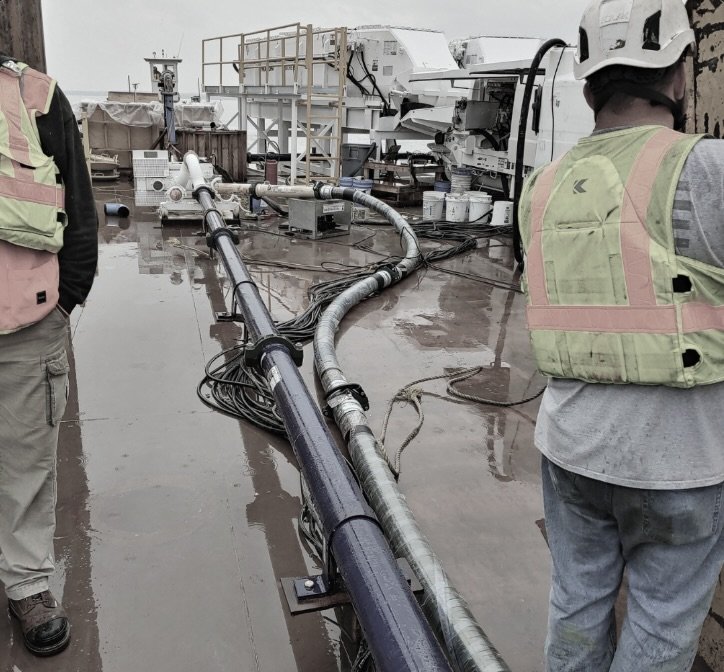
A study pumped mixes through a 1000 m pipeline, demonstrating why flow assessment needs to reflect the full line rather than aggregate size alone. Pipeline length and layout, mix composition and the required delivery rate all influence the pressure needed to maintain movement. Larger particles can alter flow conditions, but aggregate size by itself doesn’t provide a complete pressure prediction.
For practical planning, assess the mix and pipeline together. The maximum aggregate size must fit the pipe, and the mix needs enough cohesion and workability to travel without interruption. These factors are especially important for long delivery distances or routes with changes in direction. Use the assessment to guide equipment and pipeline planning, rather than treating aggregate size as a stand-alone pressure setting.
For support with pumping equipment decisions, discuss your concrete pumping requirements.
Equipcon: Mobile Concrete Pumps
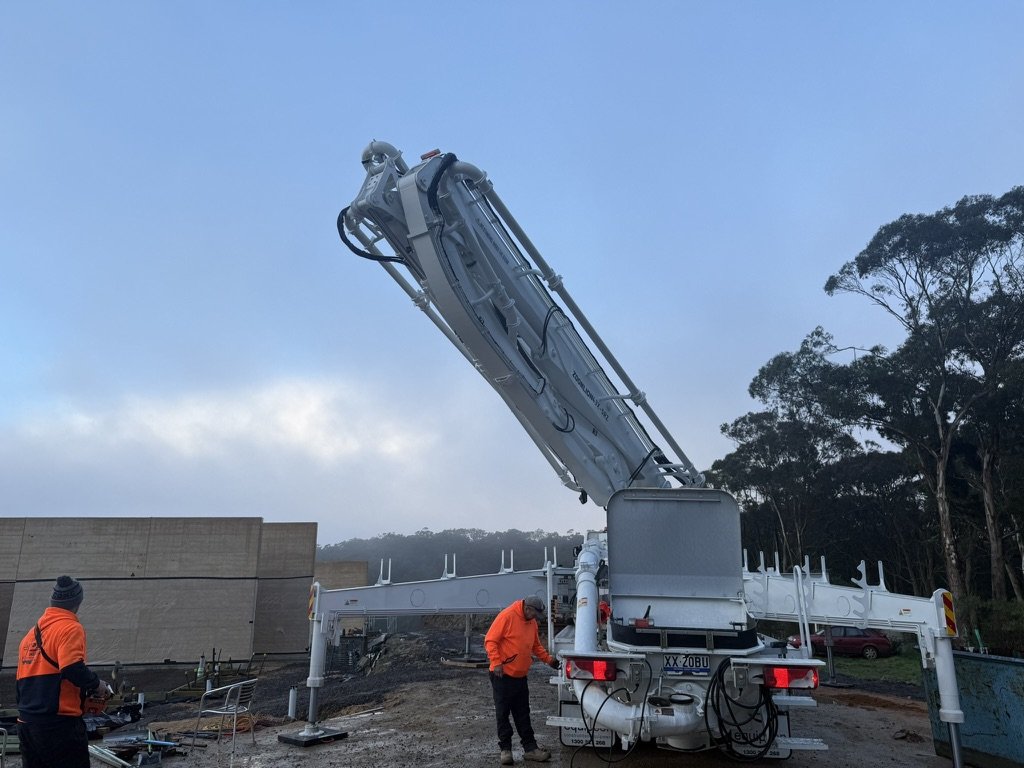
Equipcon specialises in high-rise concrete placing booms and high-pressure static concrete pumps. For projects requiring a mobile setup, Equipcon also offers Mobile Concrete Pumps; Stationary Concrete Pumps suit fixed pumping arrangements.
For elevated placement, high-rise and self-climbing Concrete Placing Booms support project requirements. Equipcon is the exclusive dealer of Telant Pipeline, with a double-wall pipeline and the EquipconXanjer product line among its upcoming expansions.
Equipcon also supplies concrete pump spare parts, pipeline accessories and provides concrete pump repairs. Contact Equipcon to discuss your pumping equipment requirements.
Plan the mix and equipment together
Understanding the impact of aggregate size on concrete pumping is a useful starting point, but the mix must also suit the pipeline and placement demands. Bring these requirements into equipment planning early. A clear picture of the aggregate, mix behaviour, delivery route and placement conditions helps align the pumping setup with the work ahead.
Equipcon can help you consider equipment options in relation to your project requirements. Use that conversation to explain the planned mix and placement conditions, then discuss which pumping arrangement best suits the job. If you’re preparing for an upcoming pour or reviewing an existing setup, contact Equipcon to discuss your pumping needs. A well-planned approach gives your team a sound basis for moving from mix design to site preparation.
Frequently Asked Questions
What is the recommended maximum aggregate size for concrete pumped through different pipe diameters?
Use the pipe diameter as the basis for setting the maximum particle size: the general recommendation is no more than one-third of the pipe diameter, with one-quarter a more conservative proportion. For a 125 mm pipe, maximum sizes are 40 mm for pebbles and 30 mm for crushed stone. A 6-inch line has a stated maximum recommendation of 2 inches.
How do coarse aggregate size and grading affect blockages and segregation during pumping?
Oversized particles or uneven grading can interrupt flow through the line and contribute to blockages. A balanced range of particle sizes helps the mix pack cohesively. Gaps between coarse particles can allow paste and water to move separately, increasing the risk of segregation. Assess the combined grading, not just the largest stone, to judge whether the mix is likely to remain uniform during pumping.
What aggregate sizes are commonly specified for pumped concrete in Australia?
Coarse aggregate sizes of 10 mm, 20 mm and 25 mm have all been included in pumped-concrete testing. These examples don’t establish one standard size for Australian projects: selection depends on the pipe opening and the mix design. A 20 mm aggregate, for example, must still be assessed against the pipe’s allowable maximum and the required workability.
How does aggregate size affect concrete pumping rates and pump selection?
Aggregate size can change concrete flow behaviour, affecting the conditions used to predict delivery rate. Pump selection also depends on the pipeline route, required placing reach, mix composition and the pressure needed to move the concrete. A target rate alone is not enough: assess the mix and delivery setup together to select suitable pumping equipment.
What steps reduce blockage risk when pumping concrete with large aggregate?
First, compare the largest particles with the pipe diameter and choose aggregate grading that supports a cohesive mix. Account for particle shape and moisture condition, since dry aggregate can absorb mix water under pressure. Keep the mix workable and consistent, and match the pump and pipeline arrangement to the required route. Don’t rely on pressure alone to push an unsuitable mix through the line.
Comments