
Hydraulic Concrete Pump Repairs: The Professional Reference for Australian Fleet Owners
Updated: Jul 29
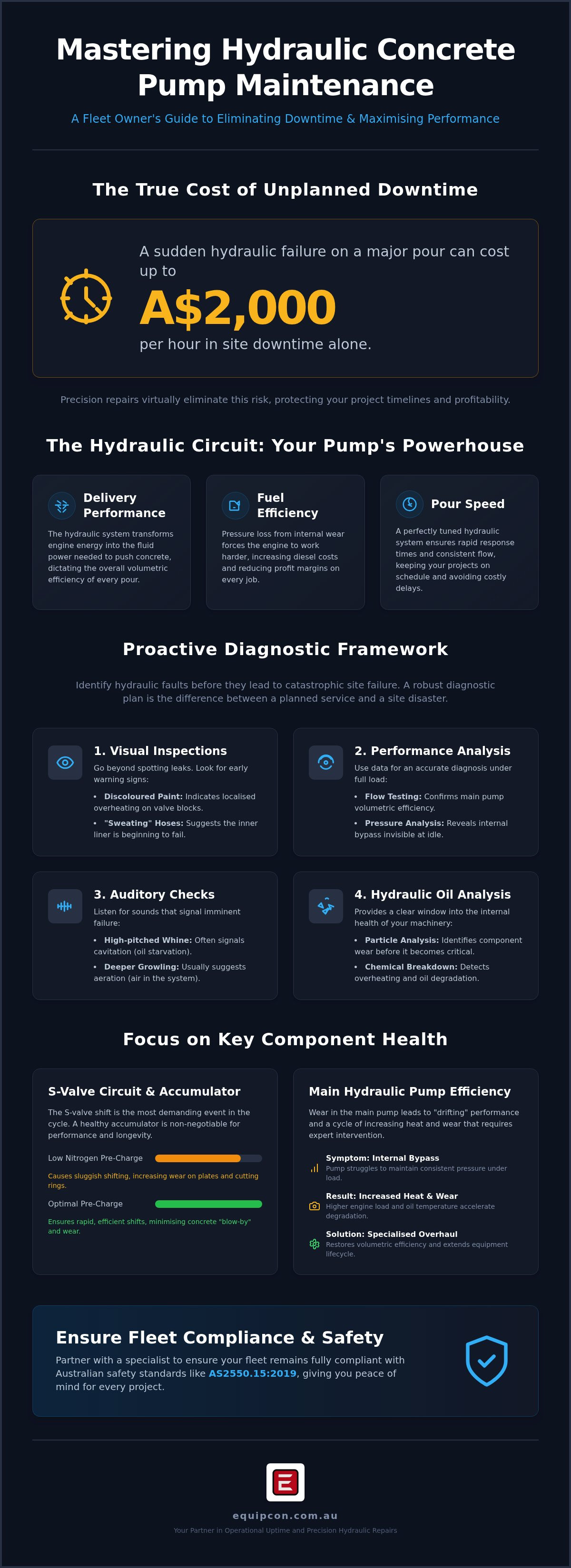
Did you know that a sudden hydraulic failure on a major pour can bleed up to A$2,000 per hour in site downtime alone? For Australian fleet owners, this isn't just a hypothetical risk; it's a constant pressure that demands more than just a quick fix from a general mechanic. We understand that when your equipment is sidelined, your reputation and your bottom line are both on the line. Managing the complexities of hydraulic concrete pump repairs requires a seasoned partner who prioritises technical precision over temporary patches.
You deserve the peace of mind that comes with knowing your fleet is fully compliant with AS2550.15:2019 standards and ready for the next big project. This reference guide will help you master the technical requirements of hydraulic maintenance and show you how precision repairs can virtually eliminate costly site breakdowns. We'll walk you through the essential diagnostic steps, the importance of genuine spare parts, and how a proactive approach to maintenance can significantly extend your equipment’s lifecycle. By the end of this article, you'll have a clear pathway to achieving zero unplanned downtime and a more resilient, profitable operation.
Table of Contents
The Critical Role of Hydraulics in Concrete Pumping Performance
The hydraulic circuit is the primary driver behind every successful pour. It transforms the engine's mechanical energy into the fluid power required to push dense concrete through hundreds of metres of pipeline. Without a perfectly tuned system, even the most robust concrete pump becomes an expensive paperweight. When things go wrong, seeking professional hydraulic concrete pump repairs isn't just about fixing a leak. It's about restoring the volumetric efficiency that keeps your site running on schedule.
Hydraulic efficiency directly dictates your fuel consumption and pour speed. A system that's losing pressure through internal wear forces the engine to work harder to maintain the same output. This doesn't just eat into your profit margins through higher diesel costs; it also generates excessive heat. Thermal management isn't just about cooling; it's about longevity. When oil overheats, it breaks down chemically, forming varnish that can stick to sensitive valve spools. A well-maintained cooling system ensures that your pump can handle back-to-back pours in the Australian summer without a drop in performance.
Understanding the difference between open-loop and closed-loop systems is vital for fleet management. In an open-loop system, oil returns to the reservoir after each cycle, which simplifies the design but often leads to slower response times. Closed-loop systems, found on many modern high-performance pumps, keep the oil in a continuous circuit. This allows for much faster directional changes and more precise control over the pumping cylinders. While closed-loop systems are more efficient, they are also more sensitive to contamination, making regular maintenance and filtration checks non-negotiable.
Main Hydraulic Pumps and Volumetric Efficiency
Wear in the main pump often shows up as "drifting" performance. You might notice the pump struggling to maintain consistent pressure as the day progresses. This is usually a sign of internal bypass, where high-pressure oil leaks back to the low-pressure side inside the pump housing. As displacement drops, engine load increases, leading to a vicious cycle of heat and wear that only expert intervention can resolve.
The S-Valve Circuit and Accumulator Health
The S-valve shift is the most demanding event in the hydraulic cycle. It requires a massive, instantaneous burst of energy provided by the hydraulic accumulator. If the nitrogen pre-charge in the accumulator is low, the shift becomes sluggish. This delay isn't just a nuisance. It increases the "blow-by" of concrete, which rapidly wears down your wear plates and cutting rings. Keeping these components in peak condition is a core part of hydraulic concrete pump repairs that many non-specialists overlook.
Diagnostic Framework: How to Identify Hydraulic Faults Before Failure
Effective diagnostics are the difference between a planned service and an A$2,000-per-hour site disaster. Waiting for a component to fail is a high-stakes gamble that rarely pays off in the Australian construction industry. A robust diagnostic framework allows you to catch minor issues before they require major hydraulic concrete pump repairs. Visual inspections are your first line of defence, but they must go beyond simply spotting a puddle of oil. You should be looking for discoloured paint on valve blocks, which indicates localised overheating, or "sweating" hoses that suggest the inner liner is beginning to fail.
Flow testing and pressure gauge analysis under full load conditions provide the data needed for an accurate diagnosis. A pump might feel fine while idling, but internal bypass often only reveals itself when the system is under the pressure of a high-rise pour. Auditory checks are equally vital for seasoned operators. A high-pitched whine often signals cavitation, where the pump is starved of oil. A deeper growling sound usually suggests aeration, where air is being sucked into the intake side. Both conditions will destroy a main pump in minutes if they aren't addressed immediately. For complex issues, our team uses electronic diagnostic tools to interface with CAN-bus systems, ensuring all work meets national repair and diagnostic standards.
Hydraulic oil analysis acts as a window into the internal health of your machine. By testing for metal particles, you can identify which components are reaching the end of their service life. Finding copper particles might indicate wear in brass bushings, while steel flakes often suggest a failing piston or cylinder wall. If you are noticing subtle performance drops or unusual noises, our technicians can provide comprehensive diagnostic support to pinpoint the root cause before a total breakdown occurs.
Pressure Testing and Relief Valve Calibration
Setting the correct cracking pressure is critical for both safety and performance. If relief valves are set too high, you risk causing structural stress on the boom or bursting high-pressure lines. If they're set too low, the pump will stall during demanding pours. We always perform these tests at full operating temperature to ensure the oil viscosity matches real-world site conditions.
Advanced Fault Finding for Intermittent Issues
Intermittent "shuddering" in the boom or pumping cylinders can be notoriously difficult to track down. We often use thermal imaging to identify internal blockages or valves that are sticking due to varnish build-up. By monitoring pilot pressure drops in the control circuit, we can isolate whether the fault is mechanical, hydraulic, or an electronic signal error in the control system.
Specialised Repair Solutions: From Cylinder Resealing to Main Pump Overhauls
High quality hydraulic concrete pump repairs rely on the perfect synergy between technical skill and the quality of the spare parts used. When a machine is stripped down in the workshop, the goal is always to return it to its original volumetric efficiency. For many Australian fleet owners, a standard reseal of a medium sized cylinder, which often includes a light polish of the rod, typically costs between A$1,200 and A$2,500. While this is a significant investment, it's far more economical than the alternative of a full rebuild on a large, heavy duty cylinder, which can exceed A$15,000 if ignored for too long.
Deciding between a main pump overhaul and a total replacement is a critical financial crossroad. With a new concrete pump truck costing anywhere from A$300,000 to over A$1 million, extending the lifecycle of your existing main pump through precision engineering is often the smartest move. If the pump housing remains within tolerance, we can replace the internal rotating groups and wear plates to restore factory performance. This process also involves re-coring hydraulic oil coolers. In the harsh Australian climate, a cooler that isn't operating at 100% capacity will lead to oil thinning and accelerated component wear, making thermal stability a top priority during any major overhaul.
Contamination control is another pillar of successful repair. We focus heavily on replacing water box seals and piston rams to prevent cement slurry from migrating into the hydraulic circuit. If concrete fines enter the oil, they act as an abrasive paste that can destroy a main pump in a single shift. Our process includes a comprehensive system flush to ensure that no debris from a previous component failure remains to threaten your newly installed parts.
Cylinder and Piston Ram Maintenance
Scoring on chrome rods is a primary indicator of impending seal failure. If you notice vertical scratches on the rod, it's only a matter of time before the hydraulic oil begins to bypass. The water box serves as a vital cooling and lubrication chamber for the concrete pistons, preventing friction heat from reaching the hydraulic seals. This is why concrete pump piston rams require regular inspection. Catching a worn ram early prevents the contamination of the entire hydraulic system.
Valving and Manifold Repairs
Achieving zero-leak performance requires more than just changing O-rings. We lap valve seats to ensure a perfect mechanical seal and test solenoid electrical coils under load. It's common for a coil to work perfectly when cold but fail once the machine reaches operating temperature on site. By testing these components under heat, we eliminate the intermittent "ghost" faults that frustrate operators and cause unplanned downtime.
The True Cost of Downtime: Why Precision Matters in Repairs
When a stationary pump fails on a high-rise site, the financial clock starts ticking immediately. Industry data suggests that concrete pump downtime costs between A$500 and A$2,000 per hour, depending on the scale of the project. On a major CBD pour, where multiple crews and a continuous line of agitators are waiting, those figures can escalate quickly. Choosing a cut-price option for hydraulic concrete pump repairs might save a few hundred dollars upfront, but it often invites a repeat failure that costs tens of thousands in lost productivity and site standing charges.
Safety is the silent partner in every repair. A hydraulic hose failure during a high-pressure pour is not merely a mechanical issue; it is a significant site hazard. While replacing a hydraulic hose typically costs between A$50 and A$200, the risk of a high-velocity oil injection or a sudden boom drop is far more expensive. Using "cheap" aftermarket seals is another false economy. These components often lack the thermal resistance required for Australian conditions, leading to premature hardening and bypass. This is why we insist on using concrete pump spare parts Australia that meet or exceed OEM specifications. Reliable parts are the foundation of a safe, compliant fleet.
Precision in repair work ensures that your equipment remains a productive asset rather than a liability. If you want to protect your bottom line, it's vital to book a professional inspection before minor leaks become major site shutdowns.
The Secondary Damage of Hydraulic Failure
A catastrophic pump failure rarely stays confined to a single component. When a main pump "grenades," it sends metal shards and debris through the entire hydraulic circuit. If you don't perform a comprehensive system flush, those particles will quickly destroy your valve blocks and cylinder seals. The cost of preventative maintenance is negligible compared to the expense of cleaning a contaminated circuit and replacing multiple high-value components simultaneously.
Precision vs. Patch-Ups
Professional calibration is essential after any major component replacement. Simply bolting on a new pump isn't enough. You must set the hydraulic timing and pressure relief levels to ensure smooth operation. Correct timing reduces the "hammer" effect in the delivery lines, which significantly lowers wear on your pipeline and accessories. The long-term ROI of investing in expert concrete pump repair services is found in the extended lifecycle of the entire machine, not just the part that was fixed.
Equipcon’s National Repair Network: Your Partner in Operational Uptime
Operating a fleet across state lines requires more than just a local mechanic; it demands a national support structure that understands the urgency of your project timelines. Our "boots-on-the-ground" approach ensures that whether you are pumping in a major CBD or a remote infrastructure site, expert help is never far away. We've established a network of state-of-the-art service depots across Australia, designed specifically to handle the heavy-duty requirements of hydraulic concrete pump repairs. These facilities aren't just workshops. They are hubs of technical excellence where we combine 30 years of experience with the latest diagnostic technology.
Our support spans the entire machine, covering everything from the intricate electronics of a concrete pump remote control box to full mechanical boom strip-downs. We pride ourselves on transparent communication. If a part has a long lead time or a diagnostic reveals a complex issue, we'll tell you straight away. This honesty allows you to manage your site expectations and adjust your logistics without the stress of unexpected delays. Our goal is to act as an extension of your own maintenance team, providing the turnkey readiness your business depends on.
Our Proven Repair Process
We follow a methodical progression to ensure every job is completed to factory specifications. This structured approach eliminates guesswork and guarantees a reliable result:
Step 1: Comprehensive initial diagnostic and pressure testing to identify the root cause of the fault.
Step 2: Provision of a detailed quote and a transparent timeline, so you know exactly what to expect.
Step 3: Precision assembly in a clean-room environment using genuine spare parts from major manufacturers.
Step 4: Full-load testing and final safety certification to ensure the machine is site-ready.
Compliance and Certification Services
Staying compliant with Australian safety standards is a non-negotiable part of fleet ownership. We facilitate both annual and six-yearly boom inspections in accordance with AS2550.15:2019. This updated standard focuses on a comprehensive periodic inspection regime, which we support through detailed structural alignment checks and pipeline thickness testing. By identifying thin spots in your delivery lines before they burst, we help you maintain a safe work environment. Once the hydraulic concrete pump repairs and inspections are complete, we issue the necessary certificates of clearance, giving you the documentation required to move onto any Tier 1 site in the country.
Securing Your Fleet’s Performance and Profitability
Maintaining a high-performing fleet requires moving from reactive fixes to a proactive maintenance culture. We’ve explored how understanding your hydraulic circuit and implementing a robust diagnostic framework can prevent the A$2,000-per-hour disaster of a major site breakdown. By prioritising technical precision in your hydraulic concrete pump repairs, you aren't just fixing a machine; you're securing your project's timeline and ensuring total compliance with AS2550.15:2019 standards.
With over 30 years of industry experience and a national depot network, we're here to support you through every stage of your equipment's lifecycle. Our team specialises in advanced hydraulic and electrical diagnostics to catch minor issues before they escalate into costly failures. Whether you need a main pump overhaul or a routine safety certification, we're committed to your long-term operational success. Contact the Equipcon Service Team for Expert Hydraulic Repairs today to keep your machinery ready for the next big pour. We look forward to being your seasoned partner on the ground.
Frequently Asked Questions
What are the most common signs of hydraulic pump failure in a concrete pump?
Excessive noise, increased cycle times, and rapid overheating are the most frequent indicators that your pump is struggling. You should listen for high-pitched whining, which often signals cavitation, or a deep growling sound that suggests aeration. If the S-valve shift becomes noticeably slower or the pump fails to reach its usual maximum pressure, the internal components are likely worn and require attention.
How often should I perform a full hydraulic pressure test on my equipment?
You should perform a full hydraulic pressure test every 250 to 500 operating hours or during every scheduled major service. Regular testing allows you to identify internal bypass issues before they lead to a total site breakdown. It is particularly vital to verify these pressures before starting a high-pressure pour or a demanding high-rise project where equipment reliability is non-negotiable.
Can I replace hydraulic hoses myself, or do I need a specialist?
You should use a specialist for high-pressure hose replacements to ensure the correct pressure ratings and crimp quality. While low-pressure return lines might seem simple, high-pressure delivery lines are safety-critical components. Incorrectly fitted hoses can fail under load, posing a severe risk of high-velocity oil injection injuries or sudden, uncontrolled movement of the boom or pumping cylinders.
What is the difference between a hydraulic pump overhaul and a reseal?
A reseal involves replacing the external and internal seals to stop oil leaks, whereas an overhaul involves replacing the internal rotating groups and wear components. If your pump is leaking but still maintains full flow and pressure, a reseal is usually enough. However, if you're experiencing a loss of power or "drifting" performance, a full overhaul is necessary to restore the pump’s volumetric efficiency.
Why is my concrete pump losing pressure when the oil gets hot?
Pressure loss at high temperatures is typically caused by internal bypass as the hydraulic oil thins and escapes through worn internal tolerances. As the oil temperature rises, its viscosity drops. If the pump’s internal parts are worn, this thinner oil leaks back to the low-pressure side more easily. This leads to a noticeable drop in pour speed and indicates that hydraulic concrete pump repairs are needed.
Are aftermarket hydraulic parts as reliable as genuine OEM parts?
Genuine OEM parts are significantly more reliable because they are engineered to the exact material specifications and tolerances required for high-pressure pumping. While aftermarket parts might offer a lower upfront cost, they often lack the thermal resistance needed for Australian conditions. Using genuine components for hydraulic concrete pump repairs reduces the risk of repeat failures and ensures your machine operates at its designed capacity.
What Australian Standards govern the repair and inspection of concrete boom pumps?
The primary standard is AS 2550.15:2019, which outlines the requirements for the safe use, inspection, and maintenance of concrete placing equipment. This standard mandates a comprehensive regime of periodic inspections rather than the old "six-yearly" strip-down approach. Compliance is essential for maintaining site-ready status and ensures your fleet meets the safety expectations of Tier 1 contractors.
How long does a typical hydraulic pump repair take at an Equipcon depot?
Most minor repairs are completed within 24 to 48 hours, provided the required parts are in stock. Major overhauls or complex boom strip-downs naturally take longer, often ranging from five to ten business days. We prioritise transparent communication and provide a firm timeline after our initial diagnostic so you can organise your site schedules and fleet logistics without the stress of unknown delays.


Comments