

How to Maximise Site Efficiency with a Concrete Boom Pump
Updated: Aug 4
If you think site efficiency is simply about the volume of concrete you can push in an hour, you're likely leaving thousands of dollars on the table every single day. It's a common frustration for site managers across Australia; you have a high-spec boom pump ready to go, but poor setup or a low-quality pipeline leads to hours of unnecessary downtime and skyrocketing labour costs. Reaching those awkward pour locations shouldn't feel like a gamble every time the truck arrives on-site.
We know that a seamless pour is the backbone of a profitable project, and our team is dedicated to ensuring your gear never lets you down. You'll learn how to select, set up, and maintain your equipment to ensure your Australian construction project runs like clockwork. This guide explores the synergy between leading boom pump hardware and premium Telant Pipeline accessories, while previewing innovations like the upcoming Equipcon Xanjer range and our new double-wall pipeline technology. By the end, you'll have a clear pathway to faster concrete delivery, reduced manual labour, and the kind of equipment reliability that keeps your business moving forward.
Table of Contents
Understanding the Boom Pump: The Core of Modern Concrete Placement
A boom pump is more than just a piece of machinery; it's a truck-mounted rig that uses a remote-controlled robotic arm to deliver concrete with surgical precision. For a foundational Concrete pump overview, it's helpful to recognise that these units are designed to handle high-volume pours that would be impossible with manual labour or smaller rigs. By using the boom to reach over obstacles like fences, scaffolding, or excavation pits, you eliminate the logistical nightmare of moving heavy pipelines by hand every time the pour location shifts.
Choosing between a boom and a stationary pump depends entirely on your site footprint and project duration. While stationary pumps excel in high-pressure static applications or long-term high-rise projects, the mobile boom pump offers unmatched agility for rapid-fire residential and commercial jobs. We recommend rigs equipped with high-performance hydraulic systems, such as the industry-leading technology found in Zoomlion models. These systems ensure the pump maintains a steady flow even under the harshest Australian conditions, reducing the risk of blockages or mechanical fatigue.
Key Components of a High-Performance Rig
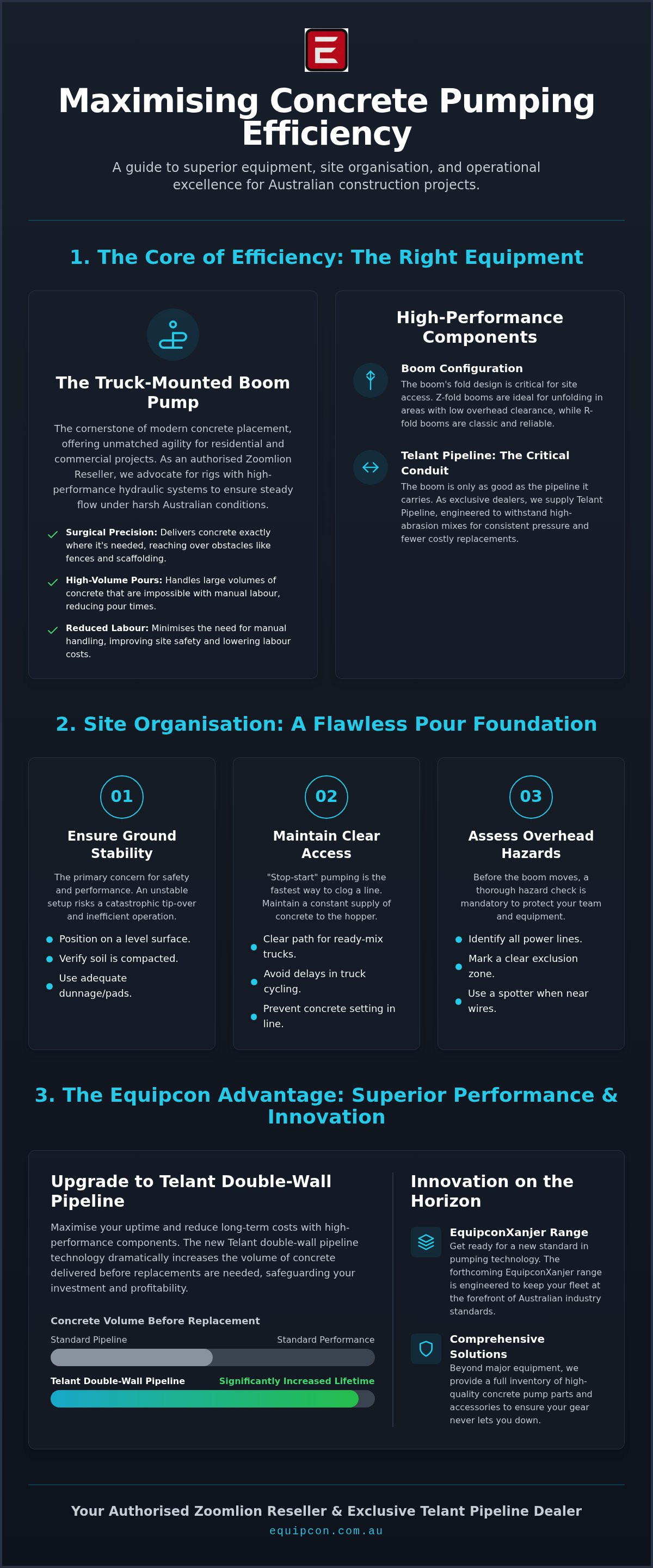
The configuration of the boom itself dictates how effectively you can work in tight urban spaces. R-fold booms are classic and reliable, while Z-fold designs allow the operator to "unfold" the arm in areas with low overhead clearance, such as inside sheds or under power lines. However, the boom is only as good as the conduit it carries. Using high-quality pipeline and accessories from Telant Pipeline ensures that pressure remains consistent from the hopper to the discharge hose. These pipelines are engineered to withstand high-abrasion mixes, which means more metres through the pipe and fewer costly replacements.
Why Reach and Mobility Matter on Australian Sites
On a busy Australian job site, time is literally money. Mobile concrete pumps significantly reduce the need for a large crew of shovel-hands because the operator can place the mix exactly where the screeders need it. Whether you're pouring a simple residential slab in the suburbs or working on a complex infrastructure project in the city centre, the versatility of a mobile rig is a game-changer. It turns a chaotic multi-hour pour into a methodical, controlled process that protects your bottom line and your team's physical wellbeing.
How to Organise Your Site for Maximum Pumping Efficiency
Efficiency doesn't start when the boom pump begins to unfold; it starts with the logistics you've arranged hours before the first truck arrives. A disorganised site leads to "stop-start" pumping, which is the fastest way to clog a line or blow a seal. To maintain a steady m3/hr target, you need to ensure the pump is positioned on a level, stable surface with a clear path for ready-mix trucks to cycle through without delay. If the supply chain to the hopper breaks down, the concrete begins to set, increasing the risk of a costly blockage.
Ground stability is your primary concern. If the soil is soft or uncompacted, you risk a catastrophic tip. While local regulations are strict, referencing global OSHA safety standards provides a solid baseline for understanding the immense loads outriggers place on the earth. Whether you're working on a tight residential block or a sprawling commercial site, you must provide adequate dunnage or outrigger pads to distribute this weight safely. To keep the machinery in peak condition during these high-stress operations, ensure you're using high-quality concrete pump spare parts Australia, which are designed to handle the specific pressures and environmental conditions of the local market.
Safety First: Outriggers and Overhead Hazards
Before the boom even moves, the operator and site manager must identify all overhead hazards. Power lines are the biggest threat on Australian sites. Mark out a clear exclusion zone and use a spotter if you're working anywhere near live wires. The operator needs to constantly monitor the boom's "envelope" to ensure site workers aren't caught in a blind spot. If you need professional equipment support to audit your site layout, reaching out to an experienced partner is always a smart move to reduce project risk.
Optimising the Pour: Communication and Flow
Clear communication between the pump operator and the placement team is the difference between a clean pour and a massive mess. Modern remote controls allow the operator to stand right next to the pour, providing a better vantage point to adjust flow rates instantly. This real-time feedback prevents "splashing" and helps manage the end hose so the mix remains consistent. Keep the hopper full at all times. A steady supply of concrete prevents air from entering the system, which is the leading cause of dangerous line surges and equipment wear.
Long-Term Performance: Maintenance and Sourcing Reliable Equipment
Maintaining a boom pump is not just about keeping the exterior clean; it is about protecting the hydraulic heart of your operation. Daily maintenance rituals, such as inspecting hose wear and ensuring proper lubrication of the swing tube, prevent the kind of mid-pour breakdowns that ruin your reputation and your profit margin. We focus on proactive care because we know that a pump sitting idle is a pump losing money. By establishing a methodical cleaning and inspection routine, you extend the lifecycle of your machinery and ensure it is ready for the next job the moment it leaves the yard.
High-abrasion mixes are common on Australian sites, and they take a heavy toll on standard equipment. This is why we recommend the new double-wall pipeline from Telant Pipeline. These pipes are engineered with a hardened inner layer to withstand extreme friction, ensuring you get significantly more "metres through the pipe" before needing a replacement. Looking ahead, we are also preparing for the launch of the EquipconXanjer range in 2026. This next-generation solution is designed specifically to meet the evolving needs of the local industry, offering even greater reliability for high-pressure applications.
The Importance of Genuine Spare Parts
Using sub-par pipeline accessories is a false economy. Cheap parts often lead to increased friction and internal turbulence, which accelerates pump wear and forces your hydraulic system to work harder than necessary. To understand how quality components impact the full lifecycle of your investment, refer to our comprehensive guide on mobile concrete pumps. Investing in genuine Zoomlion parts ensures that every component is calibrated to work in harmony, reducing the risk of catastrophic failure during a critical pour.
National Support: Reducing Your Downtime
Our commitment to your success doesn't end at the point of sale. We maintain a national network of service depots across Victoria, South Australia, Western Australia, and Queensland to provide "boots-on-the-ground" support whenever you need it. Having a readily available stock of Telant Pipeline parts and expert technicians nearby means your boom pump spends more time on the road and less time in the workshop. This national reach provides a safety net that allows you to take on larger, more complex projects with the confidence that expert help is always within reach.
Build a More Profitable Project with Precision Pumping
Running a successful pour requires more than just showing up on the day. It's about the strategic synergy between meticulous site preparation, disciplined maintenance rituals, and the use of high-performance hardware. By prioritising ground stability and choosing the right boom pump for your site's unique footprint, you significantly reduce the risk of costly downtime and keep your labour costs under control. Whether you're managing a residential slab or a complex infrastructure project, the right equipment makes all the difference to your bottom line.
As an authorised Zoomlion reseller and the exclusive Telant Pipeline dealer in Australia, we're here to support you through every stage of your equipment's lifecycle. We specialise in high-rise placing booms and high-pressure systems that are built to handle the toughest local conditions. Our national service network ensures you're never far from expert help or genuine parts, keeping your fleet ready for action. It's this commitment to reliability that helps your business grow year after year.
Explore our range of high-performance Zoomlion boom pumps today and see how our boots-on-the-ground expertise can help your next project run like clockwork. We look forward to helping you reach new heights.
Frequently Asked Questions
What is the difference between a boom pump and a line pump?
A boom pump is a truck-mounted rig featuring a remote-controlled robotic arm for high-volume, overhead delivery, whereas a line pump uses manual hoses laid along the ground for smaller pours. While line pumps are excellent for internal work with low clearance, the boom's ability to reach over fences and excavations makes it the standard for modern Australian sites. It's about choosing the right tool for your specific site footprint and pour volume.
How much reach can I expect from a standard concrete boom pump?
Reach varies by model, but standard units in Australia typically offer vertical reaches from 20 to over 60 metres. For most residential and medium commercial sites, a 36-metre to 42-metre boom pump is the industry standard. This reach allows for comprehensive coverage across a large slab without the need to reposition the truck, which is vital for keeping your project on schedule and reducing labour costs.
What are the ground requirements for setting up a large boom pump truck?
Ground requirements focus on providing a level, compacted surface that can withstand the immense point-loads from the outriggers. If the ground is soft, the rig risks tilting, which is a major safety hazard. While operators use dunnage to distribute weight, the site manager must ensure the subgrade is stable. It's a proactive step that ensures the machinery operates at peak efficiency while keeping everyone on-site safe.
How often should I inspect the concrete pipeline and couplings?
Visual inspections of the pipeline and couplings should occur before every pour to identify cracks or worn gaskets. For a high-utilisation boom pump, we recommend wall-thickness testing every 5,000 to 10,000 cubic metres. Using premium Telant Pipeline components significantly extends the life of your conduit, but regular checks are still the best way to prevent a mid-pour burst and ensure long-term equipment reliability.


Comments