
Concrete Pump Remote Control Box: The Operator’s Guide to Precision and Safety
Updated: Jul 29
The most expensive piece of equipment on your site isn't the pump itself; it's the one that stops working ten minutes into a critical slab pour. When your concrete pump remote control box fails due to signal interference or a sudden battery drop, the resulting downtime doesn't just cost you money; it puts your entire schedule and crew safety at risk. We understand that out in the Australian sun, you need gear that's as rugged as the blokes using it, not a system that's going to flake out at the first sign of dust or heat.
This guide promises to help you navigate the technical side of remote systems so you can ensure maximum site efficiency and operator safety every single day. Whether you're dealing with the complexity of syncing new receivers or trying to decide if a cable backup is worth the investment, we've got you covered. We'll walk you through how to choose a durable, dust-proof system that meets Australian Standard AS 2550.15:2019, share maintenance secrets to extend your battery life, and provide a clear troubleshooting path to get you back in action fast. It's about giving you the confidence to lead a productive site without the constant stress of equipment failure.
Table of Contents
What is a Concrete Pump Remote Control Box and Why is it Critical?
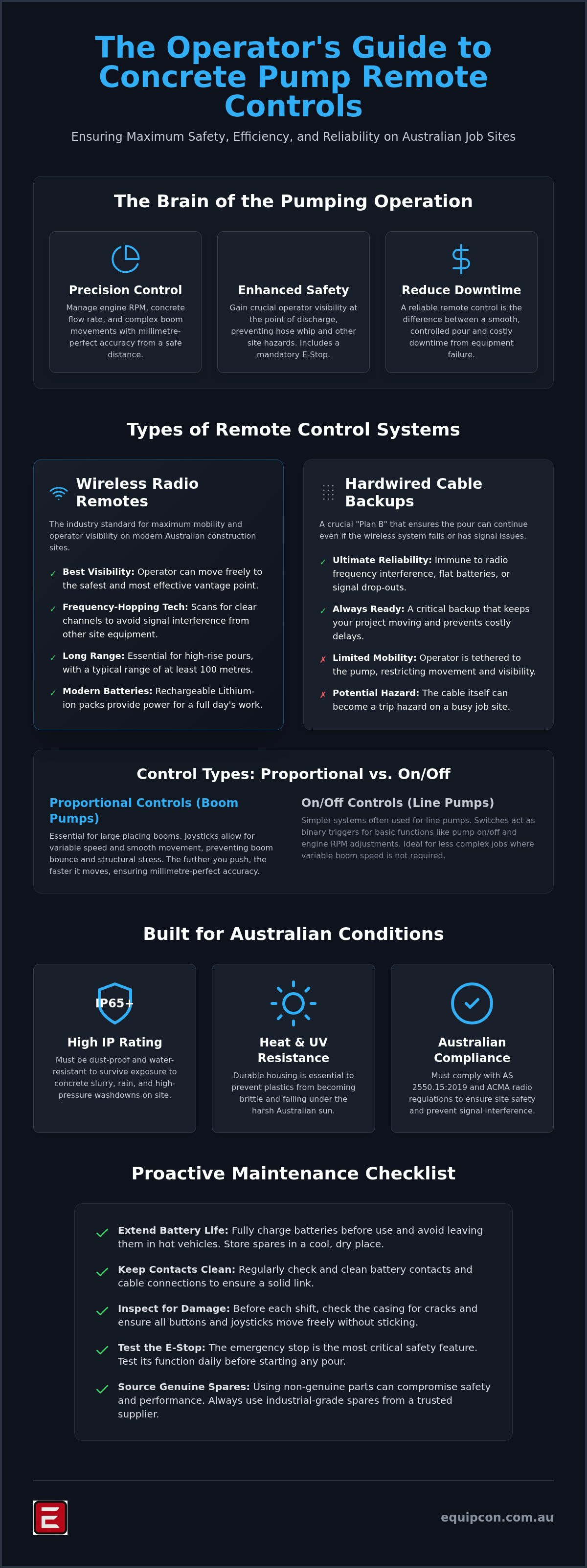
A concrete pump is a massive piece of engineering, but it is effectively useless without a reliable way to talk to it. The concrete pump remote control box serves as the primary interface between the operator and the machine, allowing for precision movements from a safe distance. Whether it is a wireless radio unit or a tethered cable backup, this box gives you total command over the pump's vital signs. It is the difference between a smooth, controlled pour and a chaotic site where the operator is constantly fighting the equipment.
It isn't just about turning the pump on and off. You are managing engine RPM to control pressure, adjusting the concrete flow rate to match the crew's pace, and navigating complex boom movements around powerlines or scaffolding. By moving the controls away from the pump chassis, operators gain a massive safety advantage. You aren't stuck behind the truck; you are right at the point of discharge where you can see exactly what is happening. This "operator visibility" is the key to preventing hose whip and ensuring the concrete lands exactly where the finishers need it.
The Brain of the Pumping Operation
Think of the remote as the brain of the whole setup. The transmitter in your hands sends high-frequency signals to a receiver mounted on the pump chassis. This needs to happen with incredibly low latency. If there is a delay between you hitting the joystick and the boom moving, you risk overshooting the mark or causing a site accident. This level of control is especially vital for mobile concrete pumps, where unfolding a multi-stage boom requires millimetre-perfect accuracy to avoid structural damage or contact with site hazards.
Safety Standards and Australian Compliance
Safety isn't just a buzzword; it is a legal requirement under Australian Standard AS 2550.15:2019. Every concrete pump remote control box must feature a prominent, functional E-Stop (Emergency Stop). This button is your "kill switch" that immediately halts all movement and pumping if a hose bursts or a worker enters a danger zone. Additionally, your radio frequencies must comply with Australian ACMA regulations to ensure they don't interfere with other site communications. Buying "cheap" grey-market remotes from overseas might save a few bucks upfront, but they often operate on restricted frequencies that cause interference or, worse, fail to stop the machine when you need it most. Stick with industry-grade gear to keep your site compliant and your crew out of harm's way.
Types of Remote Control Systems for Concrete Pumps
Not all pumping jobs are created equal. A small line pump doing a backyard pool surround in the suburbs has vastly different requirements than a 56-metre boom pump working on a CBD high-rise. The choice of concrete pump remote control box depends entirely on the complexity of your machine and the environment of the pour. Understanding these differences is the first step toward reducing operator fatigue and improving site safety.
Line pumps generally utilise simpler 4-channel or 6-channel systems. These are often "on/off" configurations where the switches act as binary triggers for the pump and engine. In contrast, large placing booms require proportional controls. These joysticks allow for variable speed movement; the further you push the stick, the faster the boom moves. This precision is vital for meeting international OSHA safety standards and Australian regulations, as it prevents the jerky movements that can lead to boom bounce or structural stress. If you're operating a boom, proportional control isn't just a luxury; it's a necessity for safe placement.
Wireless Radio Remotes: The Industry Standard
Most modern crews prefer wireless systems because they offer the best operator visibility. These units use frequency-hopping technology to constantly scan for clear channels. On a busy site with cranes and other radios, this prevents your pump from twitching or losing signal due to interference. High-rise pours often require a range of at least 100 metres to ensure the operator can move freely on the deck while communicating with the receiver on the truck. Today's industrial remotes typically feature rechargeable lithium-ion battery packs, providing enough power for a full day's work on a single charge without the memory-loss issues of older Ni-Cad batteries.
Cable Remotes and Hybrid Systems
Wireless technology is great until it isn't. Dead zones are a reality in the Australian construction industry, especially when working inside heavily reinforced concrete basements or tunnels where radio waves can't penetrate. This is why every professional outfit should carry a backup cable remote. Hybrid boxes are the gold standard here. They allow you to plug in a physical tether the moment your wireless signal drops or your battery fails. This ensures the pour doesn't stop, saving you from the nightmare of a blocked pipe or cold joint. If you're looking to upgrade your current setup, our team can help you find the right concrete pump spare parts to ensure you always have a reliable "Plan B" ready to go.
Key Features for the Australian Construction Environment
Operating a concrete pump remote control box in the Australian sun presents challenges that European or American manufacturers don't always consider. When the mercury hits 40 degrees across our vast continent, the internal temperature of a handheld remote can soar much higher, potentially leading to circuit board failure or battery swelling. Choosing a unit designed for these extremes isn't just about comfort; it's a vital safety feature that prevents the machine from becoming unresponsive mid-pour. High-visibility casings in safety orange or neon yellow are also essential. They ensure the remote doesn't get left on a deck or buried under a tarp where it could be crushed by a reversing agitator.
Ergonomics play a massive role in site productivity too. Your operators are likely wearing heavy-duty riggers gloves, so the joysticks and buttons must be spaced widely enough to prevent accidental activation. A well-designed box provides tactile feedback; you should feel a distinct "click" when a function is engaged. This allows for "blind" operation, letting the operator keep their eyes on the hose and the crew rather than looking down at the controls every five seconds.
Dust, Slurry, and Water Resistance
Concrete work is inherently messy, and fine cement dust is surprisingly conductive. If your box isn't properly sealed, this dust can penetrate the casing and cause short circuits that lead to intermittent signal loss. This is why checking the Ingress Protection (IP) rating is mandatory. We recommend nothing less than IP65, which protects against low-pressure water jets during wash-down; however, IP67 is the gold standard for its ability to withstand temporary immersion in slurry. Additionally, ensure the casing is made from UV-stabilised plastics. Without this protection, the relentless Australian sun will make the housing brittle within a few seasons, leading to cracks that compromise the internal electrical seal.
Battery Management and Charging Solutions
Commercial pours can run for twelve hours or more, making battery endurance a critical factor for your fleet. Having "hot-swappable" batteries allows an operator to change power sources in seconds without losing the sync between the transmitter and the pump. For maximum readiness, your trucks should be fitted with in-cab charging cradles that run on 12V or 24V systems, ensuring a fresh spare is always at hand. In the context of daily pump use, battery cycle life represents the number of full charge and discharge sequences the battery can complete before it loses its ability to hold a meaningful charge. Investing in high-quality lithium-ion cells ensures your remotes stay in the field longer before requiring a replacement.
Maintenance and Troubleshooting Your Remote Control Box
Your concrete pump remote control box is a precision instrument that lives in a brutal environment. Between the abrasive cement dust and the constant vibration of the pump, it's only a matter of time before components show signs of wear. Establishing a strict cleaning routine after every pour is the easiest way to prevent unplanned downtime. Dried slurry inside a button housing can cause it to stick, which might lead to a dangerous "runaway" pump situation. A simple wipe-down with a damp cloth and a soft brush for the crevices will keep the interface responsive and safe.
Antenna health is another common point of failure that operators often overlook. On the transmitter, the "rubber ducky" antenna can become brittle and crack in the Australian sun, allowing moisture to seep into the electronics. Similarly, the receiver antenna on the pump chassis is prone to being knocked by low-hanging branches or site debris. If you've recently replaced a unit, the process of syncing or "pairing" the new box to your pump usually involves a specific sequence of button presses or a security code entry. If the system still won't talk, it might be time to book in for professional concrete pump repair services to diagnose deeper electronic faults.
The 5-Step Signal Loss Troubleshooting Guide
When your signal drops mid-pour, don't panic. Follow this logical sequence to find the fault fast:
Step 1: Check Battery and Contacts. Swap to a fresh battery and inspect the metal contact points on the remote. If you see green or white crusty build-up, clean it off with an electrical contact cleaner.
Step 2: Inspect the E-Stop. It sounds simple, but a bit of grit under the Emergency Stop button can prevent it from fully disengaging. Give it a firm twist and clear any debris.
Step 3: Test with the Backup Cable. Plug in your tethered cable. If the pump works, you've confirmed the issue is with the radio transmitter or receiver, not the pump's hydraulic solenoids.
Step 4: Identify Shielding. Are you standing behind a steel-reinforced wall or inside a lift shaft? Metal structures act as a shield. Move to a clear line of sight with the truck.
Step 5: Check Receiver Fuses. Open the receiver cabinet on the truck and check for blown fuses or loose wiring harnesses that may have vibrated free during transit.
Preventative Care for Longevity
The way you store your gear between jobs determines how long it lasts. Never leave your remote bouncing around on the floor of the ute. Instead, store it in a padded, dry case inside the cab where it's protected from temperature swings and dust. Regularly inspect the rubber "boots" or seals around your joysticks and switches. If these seals are torn, moisture will inevitably find its way to the circuit board. For complex issues or a full system health check, you can contact our technical team to arrange a full electronic overhaul and ensure your fleet stays ready for the next big pour.
Sourcing Quality Control Systems with Equipcon
When a concrete pump remote control box fails mid-pour, the pressure to find a replacement immediately can lead to poor decisions. Many contractors look toward unverified overseas sellers for a quick fix, only to find that the frequency doesn't comply with ACMA regulations or the buttons lack the necessary tactile feedback for site work. Choosing a partner like Equipcon ensures you receive a system that is fully compatible with your machine's specific wiring and hydraulic logic. As a national leader in concrete pump spare parts in Australia, we specialise in keeping your fleet operational with genuine components that exceed the demands of the local industry.
We maintain a comprehensive inventory of genuine parts for a wide range of leading industrial brands. This ensures that your new transmitter integrates seamlessly with the receiver on your pump chassis without the need for complex rewiring. If you're dealing with intermittent signal drops or "ghost" movements from inferior gear, our technical team provides the high-level support that generic retailers simply cannot offer. We encourage contractors to visit our service depots to discuss custom remote configurations. Whether you need a specific joystick layout or a specialised multi-channel setup, we can tailor a solution that matches your operator's workflow and enhances site safety.
The Equipcon Advantage: Boots-on-the-Ground Support
Our national reach across Victoria, South Australia, Western Australia, and Queensland provides you with a seasoned partner who understands local site requirements. We don't just sell components; we provide a total support package that covers both the electronic and mechanical sides of concrete pumping. If your remote isn't communicating with your hydraulic solenoids, we have the on-site diagnostic expertise to identify the fault and get you back in action. Our primary goal is to minimise your downtime and ensure your equipment remains a reliable asset on every project.
Upgrading Your Fleet Controls
If you're still relying on outdated tethered remotes, retrofitting your older pumps with modern wireless systems is one of the smartest investments you can make. The long-term ROI of a high-spec concrete pump remote control box is clear: it reduces operator fatigue, improves visibility at the pour point, and significantly lowers the risk of site accidents. Whether you need a single replacement unit or a fleet-wide upgrade, we provide the turnkey readiness and after-sales care you need to grow your business. Reach out to our technical team today for part sourcing or to book your next system overhaul at one of our national service centres.
Optimise Your Pumping Fleet for Future Projects
A high-spec concrete pump remote control box is more than just a convenience; it's the primary safety interface between your operator and the machine. By prioritising IP67 ratings for dust resistance and investing in proportional controls, you reduce the risk of jerky boom movements and catastrophic site delays. Whether you're working in the heat of a Perth summer or a high-rise project in Sydney, having gear that's purpose-built for the Australian environment is the only way to ensure long-term reliability.
We're here to support your business through every stage of the equipment lifecycle. With our national service network across VIC, SA, WA, and QLD, we provide the technical guidance and genuine spare parts needed to keep your fleet moving. Don't let a faulty transmitter stall your next big pour. If you need a custom configuration or a complex electronic diagnostic, Contact Equipcon for Expert Remote Control Box Sourcing and Repairs. Our team is ready to provide the professional authority and after-sales care your business deserves. Let's get your gear ready for a productive season ahead.
Frequently Asked Questions
Can I use a generic radio remote for my concrete pump?
No, you shouldn't use generic or "off-the-shelf" remotes for heavy machinery. These units often lack the critical E-Stop integration and fail to meet Australian ACMA frequency standards required for industrial sites. A dedicated concrete pump remote control box is specifically programmed to talk to your machine's hydraulic solenoids, ensuring that safety protocols are maintained and preventing accidental machine activation.
What should I do if my remote control box gets splashed with concrete?
Wipe the concrete away immediately with a damp cloth before it has a chance to harden. Don't use high-pressure hoses directly on the buttons, as even an IP67-rated box can suffer seal failure under extreme pressure. If the slurry dries inside the switch housing, it can cause the joysticks to stick, which creates a significant safety hazard during your next pour.
How far is the typical range for a concrete pump radio remote?
Most industrial-grade radio remotes offer a reliable operating range of approximately 100 metres in an open field. However, this distance is often reduced on busy Australian construction sites due to steel reinforcement, large machinery, or scaffolding. If you're working on a high-rise deck, always try to maintain a clear line of sight to the receiver mounted on the truck to ensure low-latency signal transmission.
Why is my remote losing signal when I am close to the boom?
This is often caused by a "dead zone" or signal shadowing directly beneath the receiver antenna. If you're standing too close to the truck chassis or directly under the boom arm, the signal may be blocked by the machine's own steel structure. Moving just a few metres to the side or ensuring the antenna is positioned vertically can usually resolve these intermittent signal drops.
How often should I replace the batteries in my control box?
You should typically replace the internal battery packs every 12 to 24 months, depending on your pour frequency. While a battery might still hold a charge, its cycle life diminishes over time, leading to sudden failures mid-job. If you notice your remote losing power faster than usual in the summer heat, it's a proactive sign that the cells are reaching the end of their functional life.
Is it possible to sync one remote to multiple concrete pumps?
While it's technically possible to sync a single transmitter to multiple receivers, it's generally discouraged for safety reasons. Operating the wrong pump by mistake can lead to catastrophic site accidents. If your fleet requires this flexibility, ensure your concrete pump remote control box uses a secure "ID Key" system that requires a physical chip to be moved between units, preventing any cross-communication errors.
What is the most common cause of remote control failure on-site?
Physical damage and moisture ingress are the leading causes of remote failure on Australian sites. Dropping the unit on a hard slab or leaving it exposed to a sudden downpour can crack the housing or perish the rubber seals. Once the internal circuit board is exposed to dust or humidity, it will eventually short circuit, leading to the intermittent faults that frustrate operators and delay projects.
Do I need a special licence to operate a wireless remote for a boom pump?
Yes, in Australia, anyone operating a concrete placing boom must hold a valid High-Risk Work Licence (HRWL) Class PB. This requirement applies whether you're using the manual controls on the pump or a wireless remote. Additionally, all site personnel must hold a General Construction Induction card (White Card) to ensure they understand the safety protocols associated with high-pressure pumping and boom movement.


Comments