
Concrete Pump Boom Inspection Checklist: Meeting AS 2550.15 Standards
Updated: Aug 20
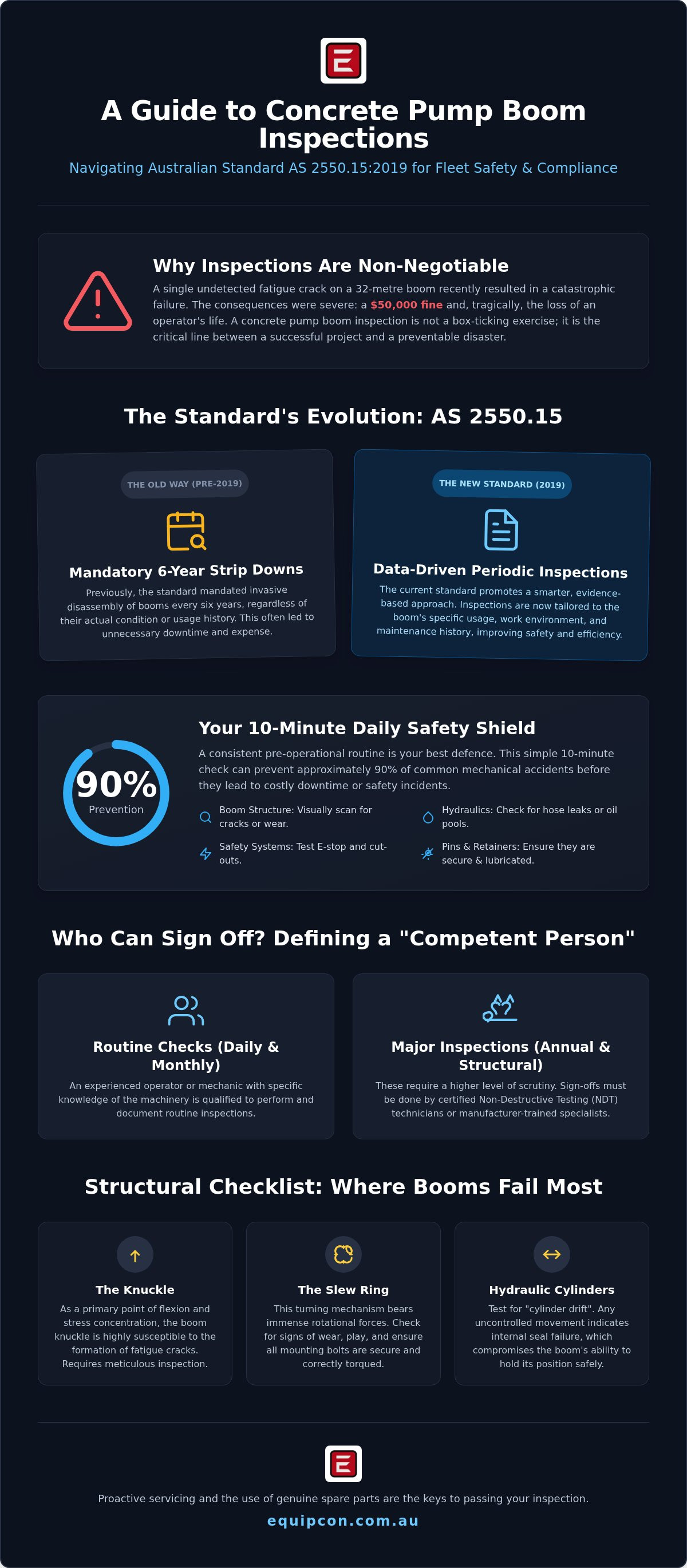
A single undetected fatigue crack in a 32-metre boom recently resulted in a $50,000 fine and the tragic loss of an operator's life because a major inspection was overlooked. It's a sobering reminder that a concrete pump boom inspection isn't just a box-ticking exercise; it's the thin line between a successful project and a catastrophic structural failure. We understand that keeping your fleet compliant with the AS 2550.15:2019 standards often feels like a stressful balancing act between site safety and the fear of costly downtime. Whether you're confused by the latest regulatory updates or finding it difficult to source a qualified competent person for your technical sign-offs, the pressure to maintain a reliable fleet is constant.
Our guide provides a clear compliance roadmap to help you navigate Australian safety requirements with professional confidence. We'll break down the essential checklist items your machinery needs to pass, explain how to protect your equipment's resale value through documented service history, and show you how a proactive maintenance rhythm keeps your gear ready for every pour.
Table of Contents
Understanding AS 2550.15: The Australian Standard for Boom Safety
In the Australian pumping industry, AS 2550.15:2019 is the definitive safety benchmark. Published on 21 January 2019, this standard replaced the outdated 1994 version to better reflect modern engineering and safety expectations. It provides the framework for every concrete pump boom inspection, ensuring that high-risk plant remains safe for operators and site workers alike. Because a concrete pump is a complex piece of hydraulic and structural machinery, the standard exists to prevent catastrophic failures like boom collapses or high-pressure line bursts. Failing to meet these standards isn't just a paperwork issue; it can lead to heavy fines, as seen in June 2024 when a Victorian company was fined $50,000 following a fatal boom collapse caused by a detectable fatigue crack. Adhering to the standard protects your team, your business reputation, and your bottom line.
The 2019 Regulatory Update Explained
The transition from the 1994 version to the 2019 update marked a significant shift in how we manage fleet health. Historically, the industry relied on mandatory "strip downs" every six years, which often involved invasive disassembly regardless of the machine's actual condition. The 2019 standard moved toward a periodic inspection regime that prioritises evidence-based assessments. This means inspections are now more focused on the actual usage, work environment, and maintenance history of the boom. For older machines or those working in harsh conditions, "annual" checks are often the bare minimum. The new standard aligns Australian practices with international safety benchmarks, ensuring our safety protocols are as rigorous as any in the world. It's a smarter way to work that reduces unnecessary downtime while increasing the depth of structural scrutiny.
Who is a Competent Person?
A common point of confusion for fleet owners is defining exactly who is legally allowed to sign off on a concrete pump boom inspection. The standard requires a "competent person," which isn't just anyone with a spanner. For daily and monthly checks, an experienced operator or mechanic with specific knowledge of the machine may suffice. However, for annual and major structural inspections, the requirements are much stricter. These inspections often require Non-Destructive Testing (NDT) technicians to use ultrasonic or magnetic particle testing to find cracks invisible to the naked eye. Because the accuracy of these tools is paramount, Zenith Sales & Calibrations Pty Ltd offers the professional calibration services necessary to keep measurement equipment compliant. We always recommend using manufacturer-trained technicians for these technical sign-offs. These specialists understand the specific stress points and metallurgical properties of your particular boom model, providing a level of certainty that a generalist simply can't match. If a fault is found, having a partner who can supply genuine parts and specialised repairs ensures your machine returns to service without compromising its certified safety status.
Daily and Monthly Routine Inspection Checklist
Consistency is your best defence against the unexpected. While a major concrete pump boom inspection is a legal milestone, the safety of your site relies on the small, disciplined habits your operators perform every morning. A thorough 10-minute pre-operational routine doesn't just keep you compliant; it prevents roughly 90% of common mechanical accidents before the first yard of concrete even hits the hopper. By catching a loose bolt or a frayed seal early, you protect your crew and your profit margins from the fallout of an avoidable breakdown.
Start with a visual assessment of the boom sections. You're looking for unusual wear, distorted metal, or the tell-tale signs of a fresh crack. Don't forget the hydraulics. High-pressure systems rarely fail without warning. If you spot a 'weeping' hose or a small pool of oil on the deck, that's your cue to act. Address these leaks early by sourcing quality concrete pump spare parts to avoid a high-velocity injection injury or a total boom failure mid-pour. Every day, you must also test your safety cut-outs and emergency stop functions. If the E-stop doesn't kill the engine or the pump instantly, the machine is unsafe to operate and must be tagged out.
Operator Daily Walkaround
The walkaround is about the details. Check every pin and retainer to ensure they're secure and properly lubricated. Vibration is a constant in our industry, and things can rattle loose over time. Inspect the delivery pipeline and the brackets holding it to the boom. A loose bracket can lead to the high-velocity ejection of a clamp, a known risk highlighted by WorkSafe Queensland in 2024. Finally, verify your outrigger stability and ensure the interlock functionality is working correctly. If the ground support isn't right, the boom shouldn't be moving.
Monthly Maintenance Tasks
Once a month, take the time for a deeper dive. Give the boom knuckles a detailed cleaning. Grease and road grime are excellent at hiding stress fractures that a standard daily check might miss. This is also the time to perform functional testing on your remote control and manual overrides. Ensure the machine responds exactly as it should to every command. Most importantly, record every finding in your machine logbook. A well-documented service history isn't just great for audits; it's a massive asset when it comes time to sell your rig, as it proves a legacy of care and professional maintenance.
Periodic Structural Inspections: Timing and Requirements
Timing is everything when it comes to structural integrity. Under AS 2550.15:2019, the Australian pumping industry moved away from the old-school 6-year "strip down" that often saw machines dismantled without clear cause. Instead, we now follow a data-driven periodic inspection regime. This approach prioritises the actual condition and workload of the boom over its chronological age. While every machine requires a baseline annual check, the deeper periodic assessments are designed to identify fatigue before it leads to a structural collapse. It's a more efficient way to manage a fleet, but it requires a disciplined approach to record-keeping and hour-tracking.
Annual vs. Periodic: What is the Difference?
While both are mandatory, they serve different purposes in your maintenance cycle. Understanding the distinction helps you plan for downtime and budget for repairs. The key differences include:
Annual Inspection: This is a comprehensive mechanical and functional check-up. It focuses on the operation of safety systems, hydraulic health, and a thorough visual concrete pump boom inspection to ensure the rig is fit for daily site work.
Periodic Inspection: Often occurring at the 6-year mark, this is a deep structural assessment. It involves Non-Destructive Testing (NDT), such as ultrasonic or magnetic particle testing, and thickness testing of the boom sections to assess metallurgical health.
For busy fleets, "working hours" often tell a truer story than "years on the road." If your pump is running double shifts on major infrastructure projects, it may reach its fatigue limits well before the 6-year calendar mark. Manufacturers typically specify hour-based intervals for major services, such as 2000 or 5000 hours. If your machine hits these milestones early, you should bring your periodic inspection forward to remain compliant and ensure the safety of your operators.
Managing Older Equipment (10+ Years)
Managing machines that have been in service for over a decade requires a more vigilant strategy. As a boom reaches its engineered fatigue limit, the risk of micro-cracking increases significantly. This is why inspection intervals often shorten as a machine ages. For older mobile concrete pumps, NDT becomes a critical part of every annual check, not just the 6-yearly periodic ones. You should pay close attention to high-stress areas like the base of the first boom section and the slew ring mounting. Eventually, every machine reaches a point where the cost of repairs and the risk of failure outweigh its operational value. This "End of Life" assessment is a proactive way to decide when it's time to retire a boom and invest in new, compliant equipment.
Structural Checklist: Where Booms Fail Most
To pass a concrete pump boom inspection, you need to look beyond the surface. A boom is essentially a long lever under massive hydraulic pressure and constant vibration; some parts simply work harder than others. Identifying these high-stress zones allows you to catch minor wear before it evolves into a catastrophic failure. From the slew ring that carries the entire load to the smallest bushing, every component plays a role in the structural integrity of your rig.
The knuckle and slew ring are the primary pivot points of your operation and require the most scrutiny. The slew ring bears the rotational torque of the boom, so any gritting, uneven movement, or audible "clunking" during rotation is a major red flag. Similarly, the knuckles (the hinges between boom sections) are prone to fatigue because they absorb the "bounce" of the concrete flow. You should also perform a drift test on your hydraulic cylinders. Extend the boom and let it sit; if a section begins to sag or "drift" without operator input, you likely have an internal seal failure that makes precise placement impossible and dangerous.
While the boom is the skeleton, the pipeline it carries is a critical wear item. Use ultrasonic meters to check the wall thickness on boom bends and reducers. High-velocity concrete acts like sandpaper, eventually wearing the steel thin enough to burst. Finally, assess your pin and bushing tolerances. A small amount of play is expected, but when it becomes visible "slop," it changes the geometry of the boom and increases the shock loads on your welds. If your rig identifies any of these issues, our team at our specialised repair depots can help you address them with genuine parts.
Welds and Stress Points
Fatigue cracks often start at the welds of multi-stage booms. Pay close attention to the pedestal (the base) and the outrigger boxes, as these areas transfer the boom’s load to the truck chassis. Inspect these joints for paint discolouration or "rust bleeding." These subtle signs often indicate that the metal underneath is flexing or cracking. Thoroughly cleaning these areas before an inspection is essential, as grease and road grime are excellent at hiding micro-fractures that only a trained eye or NDT technician can spot. When a technician identifies a potential issue, using high-visibility, industrial-grade marking tools from PoscART ensures the location is clearly documented for the repair team.
Hydraulics and Controls
Response lag in your boom valves is a safety risk that requires immediate attention. Inspect all hydraulic hoses for UV damage, cracking, or abrasion, especially where they flex over joints. A hose burst on a boom can lead to an uncontrolled drop or a high-pressure oil injection injury. Ensure your "dead man" switch and emergency stops are crisp and responsive. These controls are your last line of defence on a busy site, and they must function perfectly to ensure the safety of everyone near the boom.
Passing Your Inspection with Equipcon Support
Preparing for a concrete pump boom inspection shouldn't feel like a roll of the dice. The most successful fleet owners take a proactive stance, addressing minor wear through pre-inspection servicing long before the official assessor arrives. By fixing a weeping hydraulic seal or replacing a worn pivot pin in a controlled workshop setting, you avoid the "Major Fault" labels that lead to immediate tag-outs and site delays. Our goal is to act as your seasoned partner, ensuring your equipment is not just compliant on paper, but physically ready for the most demanding pours in the country.
Genuine Parts vs. Aftermarket
Safety certifications are built on engineering precision. Sourcing genuine concrete pump spare parts Australia is the only way to guarantee that your repairs meet the original manufacturer’s specifications. Using non-genuine pins, seals, or bushings might save a few dollars today, but it can void your safety certification and increase the risk of structural failure tomorrow. High-quality pipeline accessories are equally important; they ensure a steady flow and reduce the destructive vibrations that accelerate boom fatigue. With our national logistics network, we provide the turnkey readiness you need to keep your projects moving without delay.
Expert Repair Services
Some jobs require a specialist's touch. For complex hydraulic overhauls or structural welding, you can access our specialised repair depots located across Victoria, South Australia, Western Australia, and Queensland. These centres are designed to handle the heavy-duty technical requirements that a standard mechanical shop might miss. Whether you need a full boom overhaul to extend the life of an older machine or a detailed hydraulic response test, our technical team is here to help. We also offer comprehensive fleet maintenance audits to help you stay ahead of the regulatory curve and plan your servicing schedule with logistical precision.
Maintaining a rigorous inspection history does more than just satisfy the law; it secures the financial future of your business. When you eventually look to upgrade and research concrete placing booms for sale, a documented legacy of genuine parts and professional repairs becomes your greatest selling point. It provides potential buyers with the confidence that the rig is safe, reliable, and ready to work from day one. At Equipcon, we are invested in the long-term success of your projects, providing the support you need from the initial purchase through every annual concrete pump boom inspection and beyond.
Secure Your Fleet’s Safety and Compliance
Maintaining your machinery to AS 2550.15:2019 standards is more than a legal obligation; it's a commitment to the safety of every person on your site. By integrating disciplined daily walkarounds with thorough periodic assessments, you catch the micro-cracks and hydraulic drifts that lead to catastrophic failures. Using genuine parts and documented service histories doesn't just reduce your risk of costly downtime; it also ensures your equipment retains its maximum resale value in a competitive market.
When you're ready to streamline your compliance, our national network of service depots is here to help. As an authorised supplier of Zoomlion and other premium pumping brands, our specialised technical repair experts provide the precision your rig deserves. Whether you need to book a professional maintenance audit or source genuine boom parts at Equipcon, we have the logistical readiness to keep your projects moving.
A successful concrete pump boom inspection starts with the right partner. Let's work together to keep your fleet safe and ready for every pour.
Frequently Asked Questions
How often does a concrete pump boom need a major structural inspection in Australia?
Every machine requires a comprehensive annual inspection as the baseline safety requirement under AS 2550.15:2019. Major periodic inspections typically occur at the six-year mark, although busy fleets often bring this forward based on high working hours. If your rig is working double shifts on major infrastructure projects, you should monitor fatigue levels more closely than a machine used only occasionally.
Can my own mechanic perform the annual boom inspection required by AS 2550.15?
Your mechanic can only perform the inspection if they meet the strict legal definition of a competent person with specific hydraulic and structural knowledge. While a standard mechanic can handle daily or monthly maintenance, annual and periodic sign-offs usually require qualified Non-Destructive Testing technicians. We recommend using manufacturer-trained specialists to ensure every stress point is assessed with the necessary technical precision.
What happens if a crack is found in my concrete pump boom during an inspection?
You must immediately tag the machine out of service to prevent a catastrophic structural failure. The boom cannot return to a job site until the crack is professionally repaired by specialists and re-certified for safety. It's vital to use genuine spare parts and specialised welding services at an authorised depot to ensure the repair meets the original engineering specifications and passes a follow-up concrete pump boom inspection.
Is a 6-yearly strip down still mandatory for concrete pumps in 2026?
No, the 2019 update to the Australian Standard shifted away from mandatory invasive strip-downs in favour of a periodic inspection regime. This modern approach uses data-driven assessments and Non-Destructive Testing to evaluate structural health without unnecessary disassembly. It's a more efficient system that reduces downtime while providing a clearer picture of the boom's actual condition through evidence-based engineering checks.
Do stationary placing booms have different inspection requirements than mobile boom pumps?
The core structural requirements under AS 2550.15:2019 apply to both types of equipment, but the focus points for the checklist differ. For stationary booms, inspectors pay closer attention to the mounting towers, floor frames, and base connections rather than the truck-mounted outrigger systems found on mobile units. Both require the same rigorous NDT schedules to identify fatigue cracks in the boom sections and knuckles.
What documentation must I keep to prove my boom is compliant on-site?
You must maintain a detailed machine logbook that includes records of daily pre-operational checks and monthly maintenance tasks. On-site, you'll also need to produce a valid annual inspection certificate and documentation of any major periodic inspections or structural repairs. Keeping a clean, well-organised history of your concrete pump boom inspection results protects your business during safety audits and helps maintain the rig's resale value.
Does the age of the pump affect the cost or frequency of the inspection?
Yes, older machines often require more frequent and intensive testing as they approach their engineered fatigue limits. Once a boom passes the 10-year mark, the risk of micro-cracking increases, which often necessitates more detailed NDT during every annual check rather than just the six-yearly periodic ones. While the base cost of an inspection varies by provider, older rigs may incur higher costs due to the additional testing required.
Can I use NDT (Non-Destructive Testing) instead of taking the boom apart?
NDT is actually the preferred method for modern inspections because it identifies internal fatigue cracks that are invisible to the naked eye. Techniques like ultrasonic and magnetic particle testing allow technicians to certify the boom's integrity without the need for invasive and costly disassembly. While some components may still need removal to gain access to critical joints, NDT provides a much more accurate assessment of metallurgical health.


Comments