

Buying a Used Concrete Pump Checklist: The Professional Australian Guide
A used concrete pump is either the smartest investment your business will make this year or a six-figure liability waiting to crack under pressure. You likely recognise that the second-hand market offers incredible value for expanding your fleet; however, the fear of hidden structural fatigue or failing to meet the updated AS 2550.15:2019 standards is enough to make any contractor hesitate. We've designed this buying a used concrete pump checklist to help you navigate these risks with total confidence.
As specialists in high-pressure pumps and placing booms, we'll show you how to spot "red flag" structural issues, calculate the remaining life of wear parts, and ensure your purchase aligns with the latest Australian safety regulations, including the 2026 updates to the Queensland Code of Practice. From boom integrity to the health of your pipeline, here is how to secure a machine that delivers long-term reliability rather than unexpected downtime.
Table of Contents
Pre-Purchase Audit: The Structural and Mechanical Core
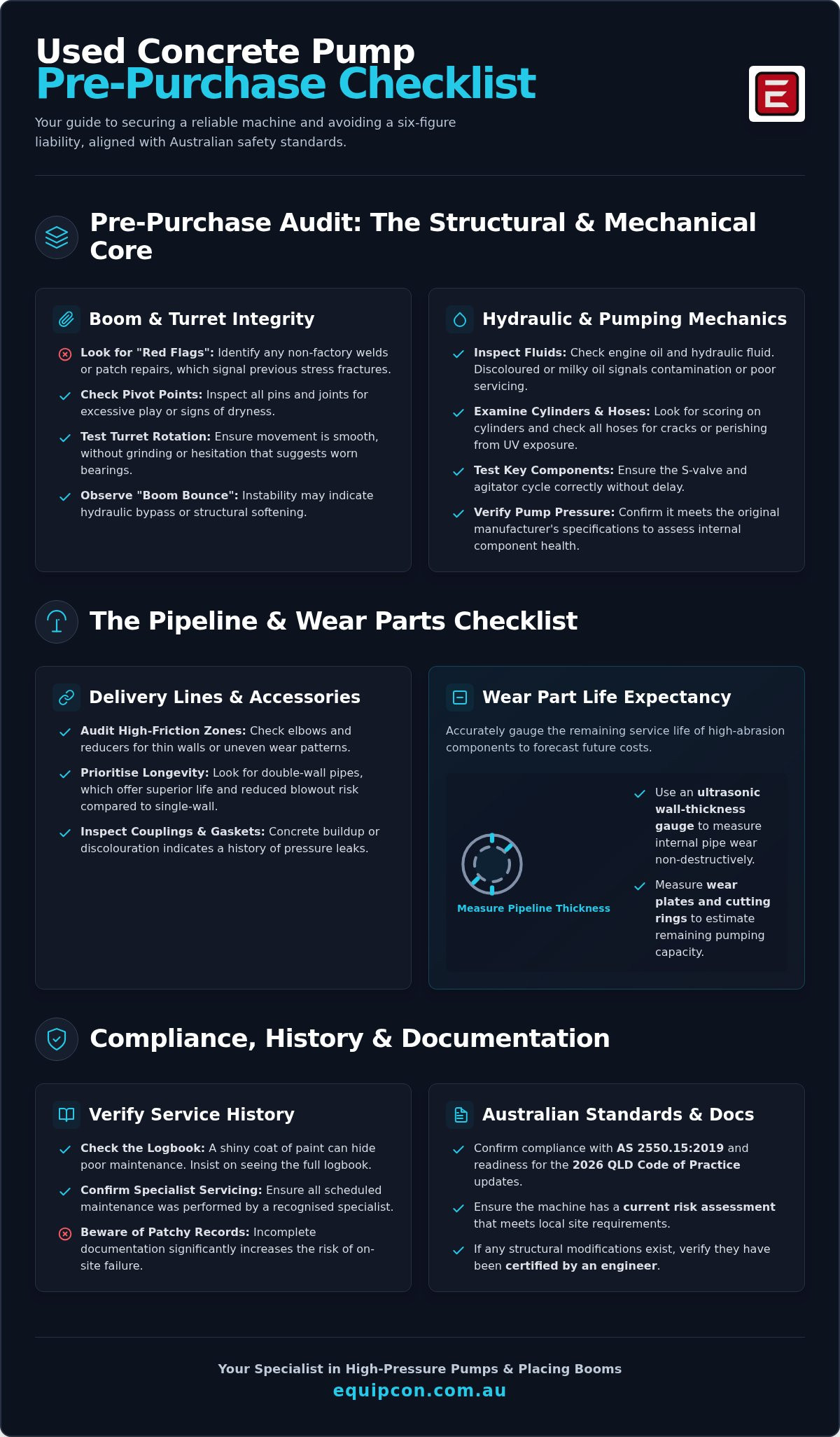
Investing in second-hand gear requires a sharp eye for detail. While understanding what a concrete pump is provides a baseline, your buying a used concrete pump checklist must scrutinise the machine's mechanical DNA. Begin with the engine and Power Take-Off (PTO) to ensure consistent performance under load. Check the engine oil and hydraulic fluid; discoloured or milky oil often signals internal contamination or a history of skipped services.
Boom and Turret Integrity
The boom is the machine's most critical safety component. Closely inspect every weld, particularly around the knuckles and turret base. If you find non-factory welds or suspicious "patch" repairs, it's a sign of previous stress fractures. Check all pivot points and pins for excessive play or signs of dry joints. Smooth turret rotation is essential; any grinding or hesitation suggests worn bearings. A stable boom reduces fatigue, so look for "boom bounce" that might indicate hydraulic bypass or structural softening.
Hydraulic and Pumping Mechanics
Hydraulic health directly impacts your site efficiency. Inspect the cylinders for scoring and check all hoses for cracks or perishing caused by intense Australian UV levels. Test the S-valve and agitator function to ensure they cycle without delay. If the pump pressure doesn't meet the original manufacturer's specifications, the internal components are likely reaching the end of their life. While Equipcon provides expert repairs for all major brands, integrating these points into your buying a used concrete pump checklist helps you decide if a machine is worth the effort or if a new EquipconXanjer model is the smarter choice.
The Pipeline and Wear Parts Checklist
Once the structural core is cleared, your buying a used concrete pump checklist must pivot to the high-abrasion components. Start with the pipeline; specifically, audit the elbows and reducers where concrete velocity causes the most internal friction. Look for thin walls or uneven wear patterns. You should also examine the hopper's agitator and ensure the grate safety switches are fully operational, as these are non-negotiable for site safety under current maintenance and inspection standards.
Inspecting Delivery Lines and Accessories
Evaluate whether the machine is fitted with standard components or high-quality pipeline & accessories like those from Telant Pipeline. If you're tackling high-volume projects, check for double-wall pipes. These offer significantly better longevity and reduced risk of blowouts compared to single-wall alternatives. Don't forget to inspect couplings and gaskets; discolouration or concrete buildup around these joints often indicates a history of pressure leaks. If the valves are seizing, it's a sign of poor cleaning habits by the previous owner.
Wear Part Life Expectancy
Using an ultrasonic wall-thickness gauge allows you to measure internal pipe wear without dismantling the entire delivery line. Measure the thickness of wear plates and cutting rings to estimate how many cubes the machine can pump before requiring a refurb. It's also vital to verify the availability of concrete pump spare parts Australia for that specific model. If parts are hard to source, your bargain purchase could spend more time in the shed than on the slab. If you're unsure about the state of a potential purchase, our specialist technicians can help you audit the machine's readiness for the field.
Compliance, History, and the After-Sales Reality
The final stage of your buying a used concrete pump checklist involves peeling back the layers of the machine's history. A shiny coat of paint can easily hide a lack of diligent servicing. You must verify that a recognised specialist has performed all scheduled maintenance and that any major overhauls are documented clearly in the logbook. If the records are patchy, the risk of a catastrophic failure on-site increases significantly. Confirm that the pump meets current WorkSafe Victoria safety standards, particularly regarding emergency stops and physical guarding.
Australian Standards and Documentation
Ensure the machine carries a current risk assessment and matches local site requirements. This is especially critical for stationary concrete pumps used on high-pressure projects. If the previous owner made any structural modifications, check that an engineer has certified the work. Without this documentation, you'll struggle to clear safety audits on major Australian tier-one sites. It's about protecting your investment and your crew.
Securing Long-Term Reliability
Owning the machine is only half the battle; you need a partner for the long haul. Identify your nearest service depot in Victoria, South Australia, Western Australia, or Queensland to ensure you aren't left stranded during a pour. Choosing an authorised Zoomlion Reseller provides the peace of mind that comes with factory-backed expertise and genuine parts. We recommend scheduling a professional concrete pump maintenance service immediately after purchase. This resets the baseline for your new asset and ensures your buying a used concrete pump checklist has truly accounted for every variable.
Secure Your Next Asset with Confidence
Navigating the second-hand market doesn't have to be a gamble if you stick to a rigorous buying a used concrete pump checklist. By prioritising structural integrity, verifying compliance with Australian safety standards, and auditing the remaining life of wear parts, you're protecting your business from costly downtime. Remember that a used machine is only as good as the support network behind it. As an authorised Zoomlion Reseller and the exclusive dealer for Telant Pipeline, Equipcon provides the technical expertise and genuine spare parts required to keep your fleet operational. Whether you need a specialist audit or a complete refurb, our national service depots in VIC, SA, WA, and QLD are ready to assist. View our range of high-performance concrete pumps and authorised Zoomlion equipment to find a reliable solution that meets your project's demands. Your next successful pour starts with the right gear and a partner you can trust.
Frequently Asked Questions
Is it better to buy a used boom pump or a used line pump?
The choice depends entirely on your typical project requirements and site access. Boom pumps provide the reach needed for high-rise or large-scale commercial slabs, whereas line pumps are better suited for residential pours or sites with restricted overhead clearance. Your buying a used concrete pump checklist should prioritise the machine type that matches your most frequent job profile to ensure a high return on investment.
How many hours is too many for a used concrete pump?
There isn't a single "cutoff" number, but machines with over 2,500 pumping hours often require a thorough audit of the main cylinders and hydraulic pumps. A well-maintained pump with higher hours is frequently a safer bet than a low-hour machine that has been neglected. Focus on the service history and the condition of the wear parts rather than just the hour meter.
What are the most common red flags when inspecting a second-hand pump?
Non-factory welds on the boom, discoloured hydraulic fluid, and visible stress fractures are the most critical red flags. If you notice "boom bounce" during operation, it often suggests structural fatigue or internal hydraulic bypass. These issues are expensive to rectify and can compromise site safety, making them essential items to tick off your buying a used concrete pump checklist before purchase.
Can I get spare parts for older concrete pump models in Australia?
You can source parts for most major brands, but availability varies significantly between manufacturers. Equipcon maintains a comprehensive inventory of spare parts and accessories across our depots in VIC, SA, WA, and QLD. We provide support for a wide range of models to ensure your second-hand asset stays on the job rather than waiting for overseas shipping.
Do used concrete pumps come with any warranty?
Most private second-hand sales are "as-is" without a warranty, which places the burden of risk on the buyer. However, purchasing through a specialist or an authorised Zoomlion Reseller often provides access to factory-backed technical support and a clearer understanding of the machine's condition. Always insist on a professional inspection to identify potential liabilities before the sale is finalised.
What is the difference between standard and double-wall pipeline?
Standard pipeline consists of a single layer of steel, while double-wall pipeline features a hardened inner sleeve designed to withstand high abrasion. As the exclusive dealer for Telant Pipeline, we recommend double-wall options for high-pressure or high-volume applications. This technology significantly extends the service life of your delivery lines, reducing the frequency of pipe rotations and replacements on-site.


Comments