

Australian Guide to Concrete Pump Pipe Couplings
Updated: Aug 4
A single failed gasket or a mismatched pressure rating is often the only thing standing between a productive day and a catastrophic pipeline blowout on a high-rise site. You've likely felt that surge of adrenaline when a connection starts to hiss or weep, knowing that every minute of downtime costs your business money and reputation. In the demanding world of Australian concrete pumping, your equipment's integrity is truly only as strong as its weakest link, which is why choosing the correct concrete pump pipe couplings is a non-negotiable safety priority. We understand that managing high-pressure static pumps and high-rise placing booms requires absolute confidence in every component of your delivery line.
This guide will help you select, maintain, and secure the right components to ensure maximum safety and zero downtime on your Australian job site. As the authorised Zoomlion reseller and exclusive dealer for Telant Pipeline, Equipcon is here to help you manage compliance with Australian safety standards while extending the service life of your gear. We will look at how to avoid leaky gaskets and clarify those confusing pressure ratings that often lead to site errors. You will also get a first look at our upcoming double-wall pipeline and the forthcoming EquipconXanjer range, designed to bring even more reliability to your fleet's high-pressure operations.
Table of Contents
Understanding the Role and Types of Concrete Pump Pipe Couplings
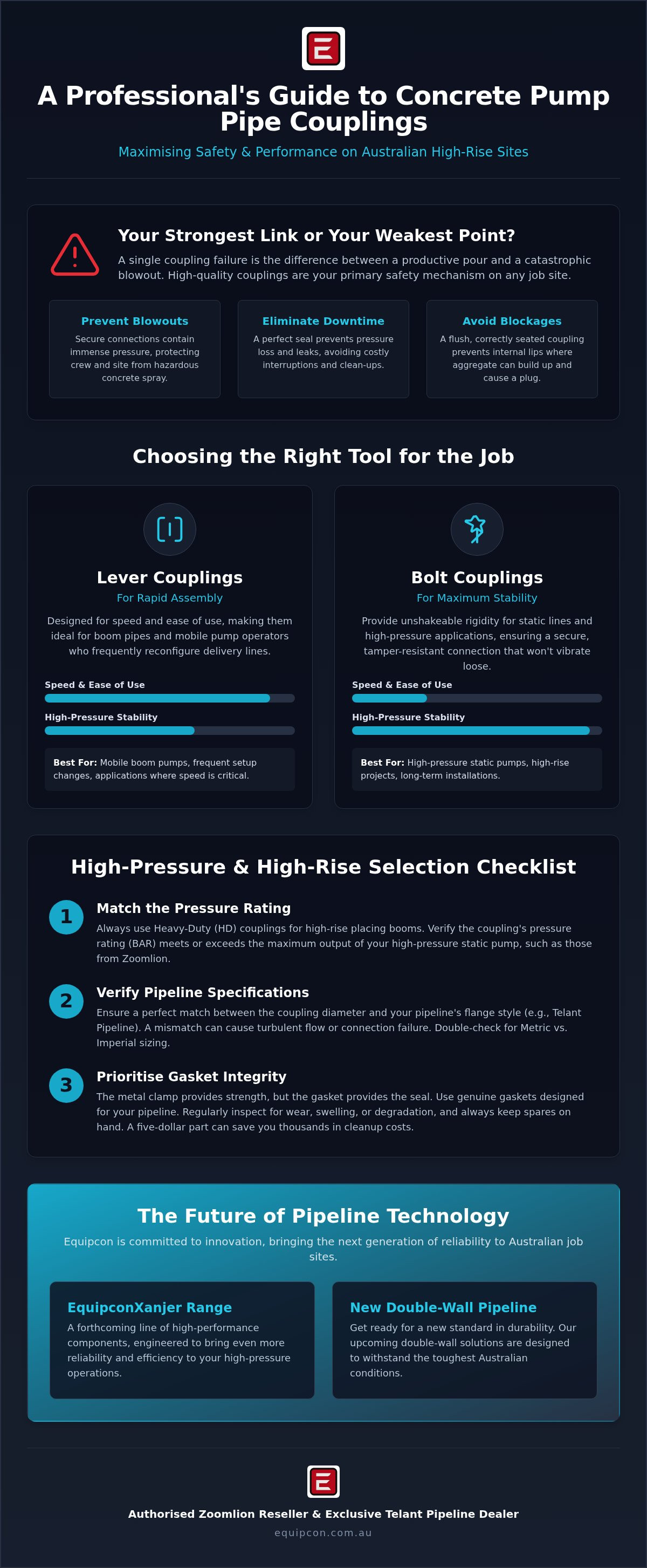
Couplings, often referred to as clamps on the job site, are the literal glue holding your delivery line together. While they might seem like simple hardware, they are actually the primary safety mechanism for joining sections of pipe. High-quality concrete pump pipe couplings do more than just connect parts; they prevent hazardous concrete leaks and pressure loss that can ruin a high-volume pour. If you're using specialised systems like Telant Pipeline, your choice of coupling must match the specific wall thickness and flange style of the pipe to ensure a flush seal. Getting this connection right is also a foundational step when troubleshooting concrete pump pipeline blockages, as a poorly seated coupling can create an internal lip where aggregate begins to build up and cause a plug.
Lever Couplings for Rapid Assembly
When you're working with boom pipes, speed and ease of use are vital. Lever couplings are designed for rapid assembly and disassembly between pours or during site setup. These are available in both fixed and adjustable configurations. Adjustable versions are particularly useful for managing gasket compression, allowing you to tighten the seal as the rubber gasket naturally wears down over time. This flexibility helps maintain a vacuum-tight connection without needing tools for every adjustment, making them a favourite for mobile pump operators across Australia.
Bolt Couplings for High-Pressure Stability
For static lines and high-pressure trailer-mounted applications, rigidity is the priority. Bolt couplings are the preferred choice here because they provide maximum stability under extreme bar pressures. Unlike lever styles, these require manual tightening with a spanner or impact wrench. This ensures a secure, tamper-resistant connection that won't vibrate loose during long-term installations on high-rise projects. They are the essential choice for high-pressure static concrete pumps where the risk of a coupling "jumping" under load must be eliminated to protect your crew and the site.
Selecting the Right Coupling for High-Pressure and High-Rise Projects
High-rise concrete placing booms and high-pressure static pumps operate in environments where standard components simply won't cut it. When you're pushing concrete hundreds of metres vertically, the pressure at the base of the stack is immense. This is where heavy-duty (HD) concrete pump pipe couplings become essential. These are engineered to withstand not just the high bar pressure, but also the constant vibration that can shake a lesser connection loose. If you are operating Zoomlion machinery, ensuring your couplings are compatible with the pump's specific output is critical for maintaining site safety and equipment longevity. Always verify that the pressure rating on your clamp matches the maximum output of your high-pressure static concrete pump before the first cubic metre leaves the hopper.
Matching Couplings to Pipeline Specs
A common mistake on busy Australian sites is a mismatch between the coupling and the pipe's flange. You must ensure the coupling diameter perfectly matches your concrete pump elbow pipes and reducers to avoid creating a turbulent flow area. It's also vital to identify whether your fleet uses metric or imperial sizing. Mixing these up leads to site misfits that cause leaks or, worse, a complete connection failure under load. If you're unsure about your current setup, our team can help you audit your high quality pipeline and accessories to ensure every connection is millimetre-perfect.
The Importance of Gasket Integrity
The metal clamp provides the strength, but the gasket provides the seal. A coupling is only as effective as the rubber inside it. We always recommend using genuine Telant Pipeline gaskets because they are designed to fit the specific grooves of our high-performance lines perfectly. You should also check for material compatibility with your specific concrete mixes. Certain chemical additives or high-friction aggregates can cause premature gasket swelling or degradation. Replacing a five-dollar gasket is a small price to pay compared to the cost of cleaning up a blowout halfway up a skyscraper. Keeping a healthy stock of spares in the truck ensures you're always ready for the next big pour.
Maintenance Standards: Maximising Service Life and Site Safety
High-pressure pumping demands respect for the hardware, especially when you're dealing with concrete pump pipe couplings that endure hundreds of cycles. Proactive maintenance is the best way to reduce project stress and avoid the "leak-and-patch" cycle that slows down a job. Start by regularly cleaning the coupling grooves; even a small amount of hardened concrete will prevent a flush seal, leading to weeping and eventual pressure loss. In our harsh Australian conditions, dust and heat can seize adjustable components, so it's vital to lubricate the moving parts of lever couplings to ensure they operate smoothly when you're under the pump.
We are constantly looking for ways to make your job easier through innovation. You can prepare for enhanced wear resistance with our upcoming double-wall pipelines and the forthcoming EquipconXanjer range. These additions to our inventory are specifically designed to handle higher volumes with less frequent maintenance intervals, keeping your fleet ready for the most demanding high-rise pours.
Inspecting for Wear and Deformity
Visual inspections should be part of your daily pre-start routine. Look for "egging" or ovality in the coupling body. If the clamp is no longer perfectly circular, it's a clear sign the part has been over-pressurised and its structural integrity is compromised. You should also replace any coupling showing signs of cracking or significant rust. While surface oxidation is common, deep pitting can lead to a sudden failure under load, putting your crew at risk and causing expensive downtime.
Safe Connection Protocols
Safety on site is often about the small details that prevent big accidents. Always use safety pins or clips on your lever couplings to prevent an accidental release during a pour. Incorrect coupling installation is a leading cause of pipeline failure on Australian sites. To stay compliant and keep your delivery lines running at peak performance, sourcing genuine concrete pump spare parts in Australia is the most reliable strategy for any professional operator. This ensures your accessories match the performance of your Zoomlion machinery and Telant Pipeline systems.
Securing Your Next Pour with Confidence
Choosing the right concrete pump pipe couplings isn't just about making a simple connection; it's about protecting your crew and your project's timeline. We've explored how heavy-duty bolt couplings provide the essential stability for high-rise booms, while proactive maintenance ensures your gaskets don't fail when the pressure is on. By matching your accessories to the high-performance standards of Zoomlion machinery and Telant Pipeline systems, you effectively eliminate the guesswork that often leads to costly site downtime. It's these small technical choices that determine whether a job runs smoothly or grinds to a halt.
As Australia's authorised Zoomlion reseller and exclusive Telant Pipeline dealer, Equipcon is deeply invested in your functional success. Whether you require immediate help with spare parts or are looking to upgrade your fleet with our forthcoming double-wall pipeline and EquipconXanjer range, our team is here to guide you. With national service depots located in VIC, SA, WA, and QLD, we provide the logistical precision and "boots-on-the-ground" support you need to keep moving forward.
Let's get your delivery lines secured so you can focus on a smooth, profitable pour.
Frequently Asked Questions
Can I use different brands of couplings on the same pipeline?
You should ideally stick to components designed for your specific pipeline system to ensure a perfect flange match. While many concrete pump pipe couplings look identical, minor variations in the shoulder profile of the pipe can prevent a flush seal. Using genuine couplings from our Telant Pipeline range ensures your Zoomlion machinery operates with the exact tolerances required for high-pressure safety and leak prevention.
How often should concrete pump pipe gaskets be replaced?
You should inspect your gaskets every day during your pre-start checks and replace them at the first sign of weeping or physical deformity. In high-volume Australian environments, gaskets endure significant thermal and chemical stress from different concrete mixes. If a gasket looks swollen, cracked, or has lost its elasticity, swap it out immediately to prevent a high-pressure blowout that could shut down your site for hours.
What is the difference between a wedge coupling and a lever coupling?
A lever coupling uses a cam-action handle for quick, tool-free assembly, while a wedge coupling relies on a metal wedge driven in with a hammer to lock the connection. Wedge styles are often preferred for static lines because they don't have moving parts that can vibrate loose or be accidentally knocked open. Lever styles remain the go-to for mobile booms where speed and frequent pipe reconfiguration are the main priorities for the crew.
Are HD couplings necessary for all mobile concrete pump applications?
Not every job requires heavy-duty hardware, but any section of the line subjected to high bar pressure must use them. While standard concrete pump pipe couplings are usually sufficient for low-pressure residential ground-line pours, they aren't designed for the forces generated by high-rise placing booms. If you're transitioning to high-pressure trailer mounted concrete pumps, the HD rating becomes a non-negotiable safety requirement to protect your equipment and your staff.


Comments